
Climate Data Technology
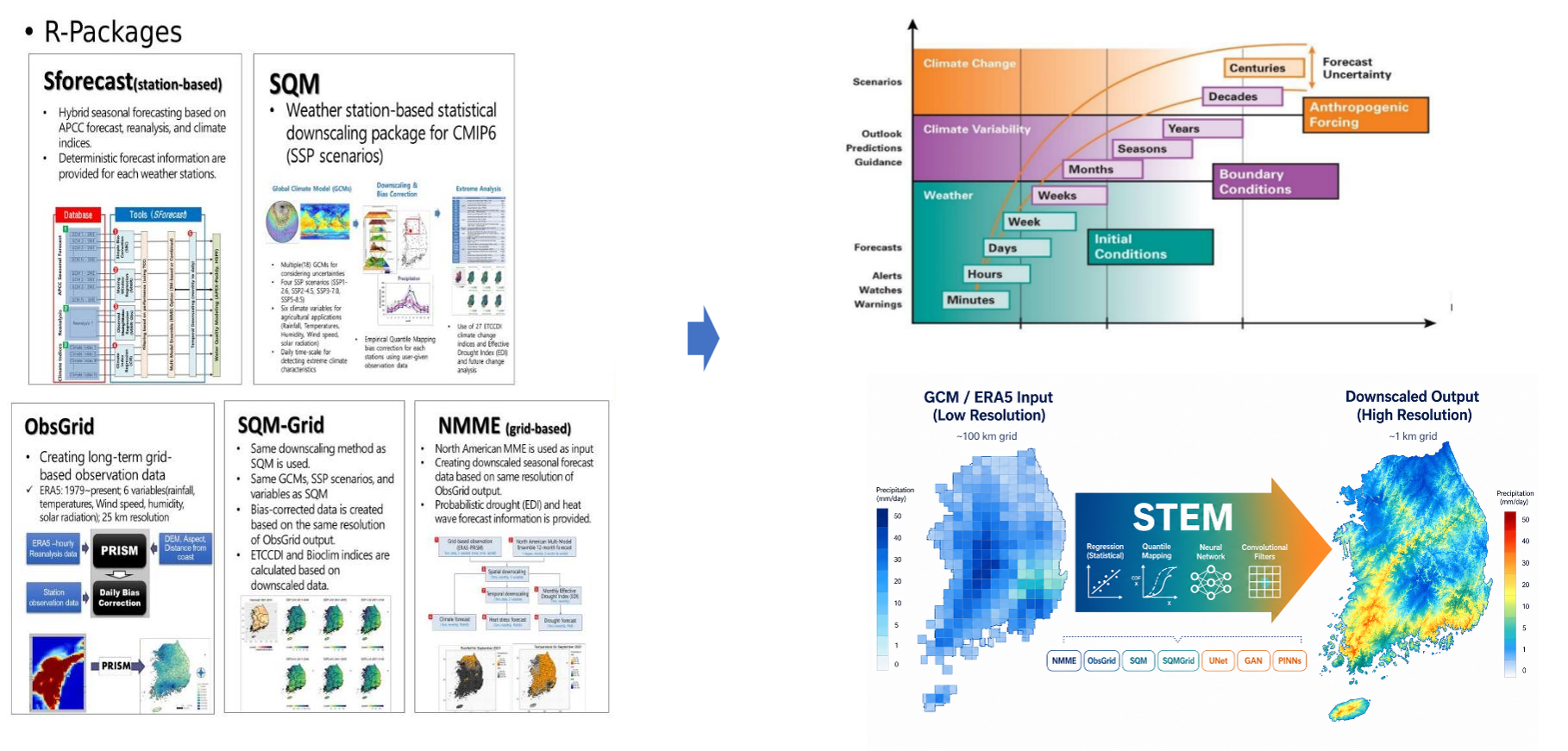
What it covers
A seamless range of time scales — from weather forecasts of minutes ahead to climate change projections decades out. Short forecasts are governed by initial conditions, seasonal variability by boundary conditions, and long-term climate change by anthropogenic forcing.
Downscaling — STEM
Global climate model (GCM) and reanalysis (ERA5) fields on a ~100 km grid are downscaled to a ~1 km grid, combining statistical regression, quantile mapping, neural networks and convolutional filters.
R packages
| Package | What it does |
|---|---|
| SForecast (station-based) | Hybrid seasonal forecasting from APCC forecasts, reanalysis and climate indices. Provides deterministic forecast information for each weather station |
| SQM (station-based) | Statistical downscaling for CMIP6 (SSP scenarios). 18 GCMs, 4 SSP scenarios (1-2.6/2-4.5/3-7.0/5-8.5) and 6 climate variables (rainfall, temperatures, humidity, wind speed, solar radiation) at daily time-scale. Empirical quantile mapping bias correction per station. Produces 27 ETCCDI climate indices and the Effective Drought Index (EDI) |
| ObsGrid (grid-based) | Creates long-term grid-based observation data. ERA5 (1979–present), 6 variables at 25 km resolution, refined with PRISM and daily bias correction against station observations, accounting for DEM, aspect and distance from coast |
| SQM-Grid (grid-based) | Same downscaling method, GCMs, scenarios and variables as SQM, producing bias-corrected data at ObsGrid resolution. ETCCDI and Bioclim indices are derived from the downscaled data |
| NMME (grid-based) | Uses the North American Multi-Model Ensemble as input to produce downscaled seasonal forecast data at ObsGrid resolution. Provides probabilistic drought (EDI) and heat wave forecast information |
Contact
Please get in touch and our team will assist you.
- Phone +82-2-6263-4964
- Email iwmi.kr@gmail.com
Personal information collected through enquiries is handled in accordance with our Privacy Policy.