
Flood Control Capacity Analysis and Integrated Operation of Agricultural Hydraulic Structures under Climate Change
The Institute of Watershed Management (IWMI) took part as a joint research institution in “Flood Control Capacity Analysis and Integrated Operation of Agricultural Hydraulic Structures under Climate Change” (RS-2020-IP320046), led by the Seoul National University R&DB Foundation with the Rural Research Institute of the Korea Rural Community Corporation. Commissioned by the Ministry of Agriculture, Food and Rural Affairs, it ran from April 2020 to December 2024 with a budget of KRW 1.39 billion.
Climate change is raising the frequency and intensity of extreme rainfall, while many of Korea’s agricultural reservoirs and drainage structures have aged beyond their original design flood control capacity. The project quantified that capacity and operated the structures as a connected system at watershed scale, strengthening flood and inundation response for farmland.
CMIP6 projections under SSP scenarios were downscaled to 60 synoptic weather stations to build a future weather database. Rainfall frequency, inflow flood, reservoir operation, river stage and inundation modules were linked in Python into an integrated farmland flood simulation system. A probabilistic flood safety standard was established from reliability analysis, and multi-objective optimisation set flood season restricted water levels balancing water supply and flood control. Decision support based on PPO and DQN reinforcement learning was developed and field-tested at the Yedang Reservoir watershed.
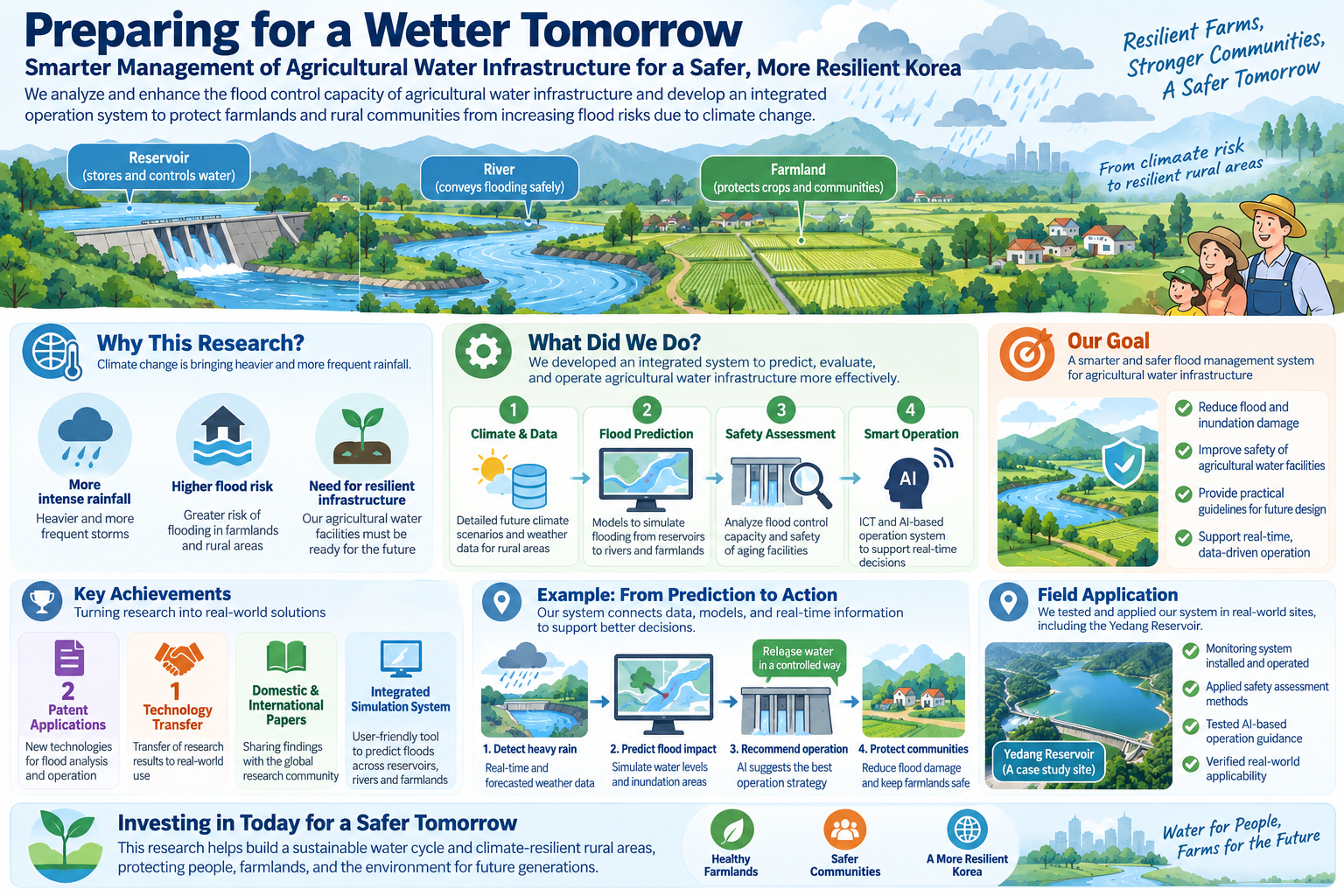
Outcomes include two patent applications, one technology transfer, eight domestic and 3.5 international journal papers, 27 conference presentations, and a draft national guideline for estimating design flood discharge. Government agencies, the Korea Rural Community Corporation and local authorities can apply these results to flood response, maintenance, design guidance and disaster prevention planning. Pre-release operating rules and probabilistic safety assessment are expected to strengthen non-structural resilience and reduce flood damage and recovery costs in rural communities.