
Predicting Ecological and Water Resource Impacts of Vegetation Succession in Dam Watersheds
The Institute of Watershed Management (IWMI) carried out a study for K-water on predicting the ecological and water resource impacts of vegetation succession in dam watersheds and on management measures to address them. The assignment ran for 565 days from 10 June 2020 to 26 December 2021, with a contract value of KRW 250 million. The Daecheong Dam basin served as the pilot site.
Forests in a dam watershed are often called a green dam. They retain water, moderate floods, sustain low flows and filter pollutants, and form the ecological network linking land and water. As they adapt to a changing climate, the forests themselves change: succession, seed dispersal and disturbance alter landscape structure and vegetation distribution, and those shifts feed back into basin water quantity and quality. The study set out to anticipate that feedback and develop management strategies accordingly.
Future weather data were generated from climate change scenarios, and seasonal forecast skill was assessed by lead time. SWAT was selected as the basin model. HSPF subdivides catchments by land use alone and cannot represent the varied soils and slopes upstream of a dam, whereas SWAT accounts for land use, soil and slope together and distinguishes coniferous, broadleaf and mixed forest. A Daecheong Dam basin model was built and calibrated using 2015 to 2019 data, achieving Nash-Sutcliffe efficiency above 0.5 at both daily and monthly time steps.
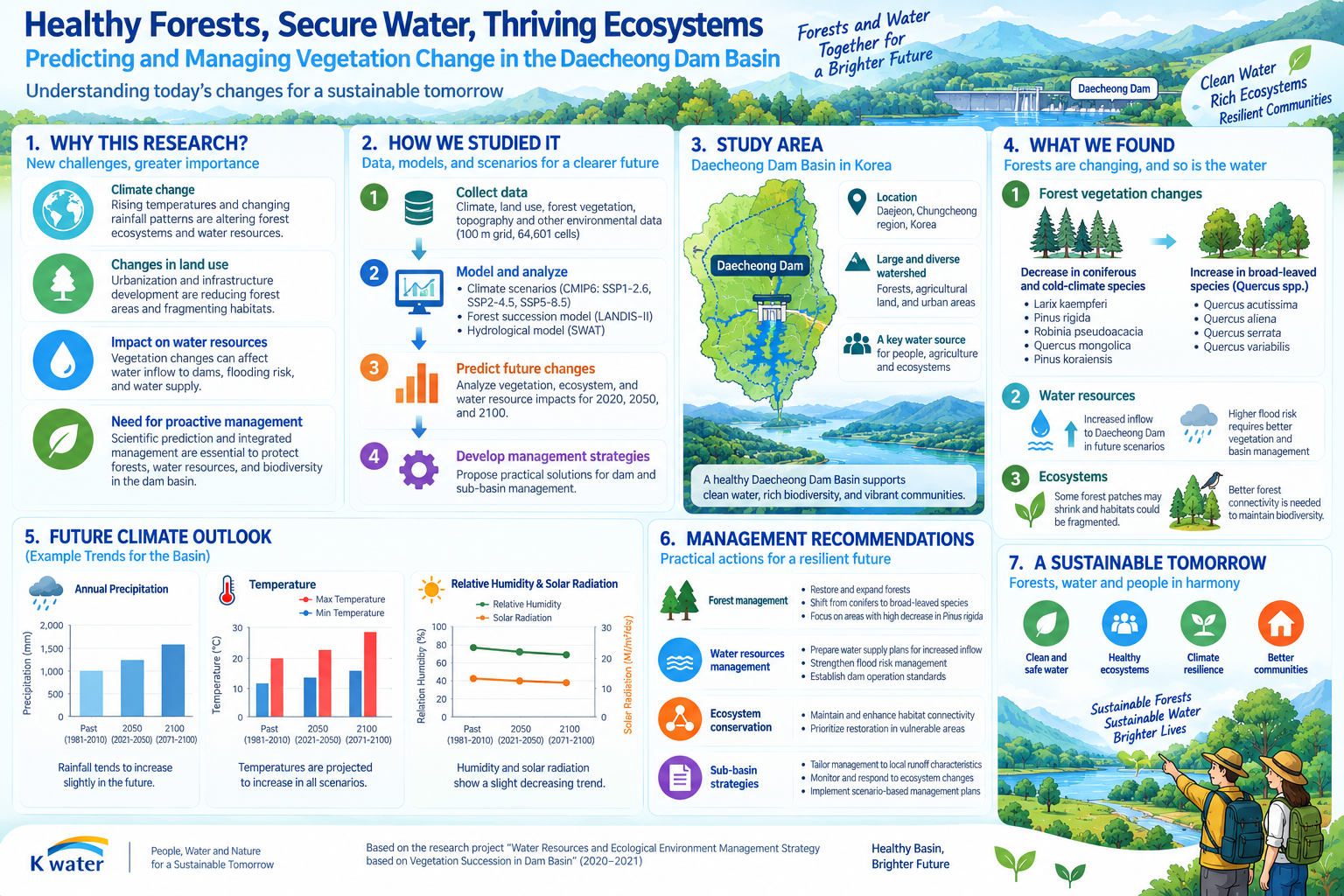
The calibrated model was applied to a baseline period of 1981 to 2010 and two future periods, 2021 to 2050 and 2071 to 2100. A multi-model ensemble reduced uncertainty from climate model selection, and three scenarios separated dam inflow from sub-basin responses. Accounting not only for climate change but for the forest change it drives distinguishes this work; the results can inform forest management and long-term water resource operation.