
Development of Streamflow Forecasting Technology for the Cook Islands
The Institute of Watershed Management (IWMI) developed streamflow forecasting technology for the Avana valley in the Cook Islands, under contract to the APEC Climate Center. The assignment ran for eight months from contract signature, with Rarotonga, the main island, as the study area.
Pacific island states are where water problems appear first and most acutely. Islands are small, with little room to store water; catchments are short, so rain runs straight out to sea; and a dry season only slightly prolonged leaves domestic supply short. Streamflow records are short and gauging stations few, making it hard to judge in advance how much water will be available. The assignment set out to establish the capability to forecast streamflow at seasonal scale.
Work began with understanding runoff behaviour in the target catchment. Seasonal rainfall characteristics were compared across Cook Islands stations, the rainfall-runoff relationship and flow variability of the catchment were established, and runoff response was analysed by land surface characteristics. Where observations are sparse, this characterisation is what a model can be built on. Climate forecast data and a catchment model were then linked into a system producing forecast information.
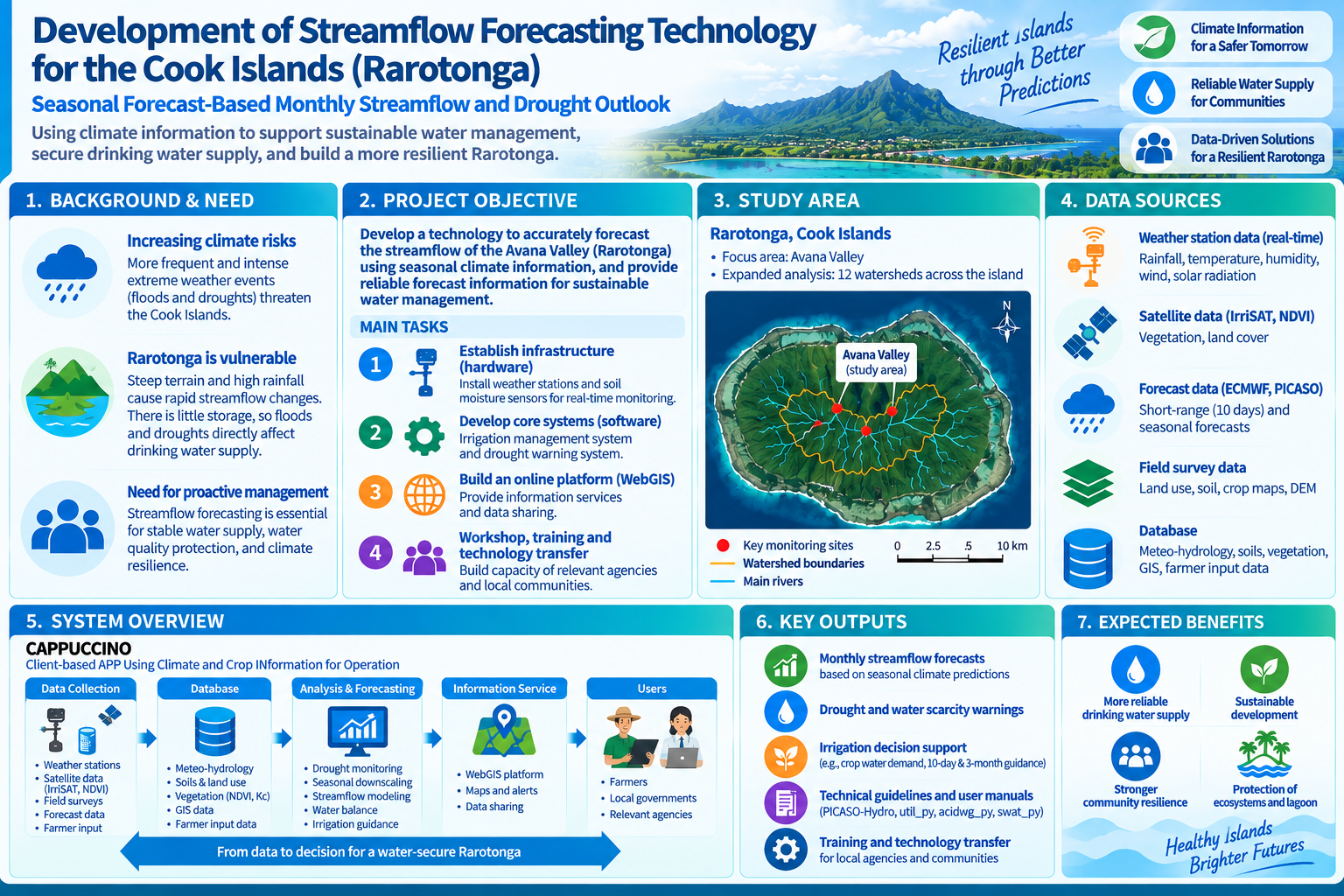
The results were set out in a final report in July 2026. With forecast information available, decisions on when to begin restricting supply or increasing storage can be taken in advance. The assignment demonstrates that seasonal forecasts can be translated into operational water management decisions even in small island catchments with limited observation, contributing to climate adaptation capacity in Pacific island states.