
Master Plan for Expanding Flood Control Capacity of Agricultural Reservoirs
The Institute of Watershed Management (IWMI) took part in a study to establish a master plan for expanding the flood control capacity of agricultural reservoirs, commissioned by the Korea Rural Community Corporation. The Korean Society of Agricultural Engineers was the lead institution, with IWMI as a research partner. The contract was signed on 8 July 2021, with a value of KRW 418.5 million.
Most agricultural reservoirs in Korea were designed decades ago. Since then climate change has increased the frequency of heavy and extreme rainfall, raising probable rainfall above the levels assumed in the original design standards, and the past decade has seen more events exceeding those standards. Meanwhile infrastructure downstream of reservoirs has grown, so an incident of the same magnitude now causes greater damage. Deciding which ageing, under-designed reservoirs to reinforce first had become urgent.
The team first established the rationale for a capacity expansion programme, setting out five grounds: rising disaster risk from climate change, increasing extreme rainfall, more frequent exceedance of design standards, greater downstream damage potential, and the combination of ageing structures with low design standards. Domestic and international precedents were reviewed. The distribution of reservoirs by year of completion was analysed to establish the extent of ageing, alongside flood case studies and the public functions of agricultural production infrastructure.
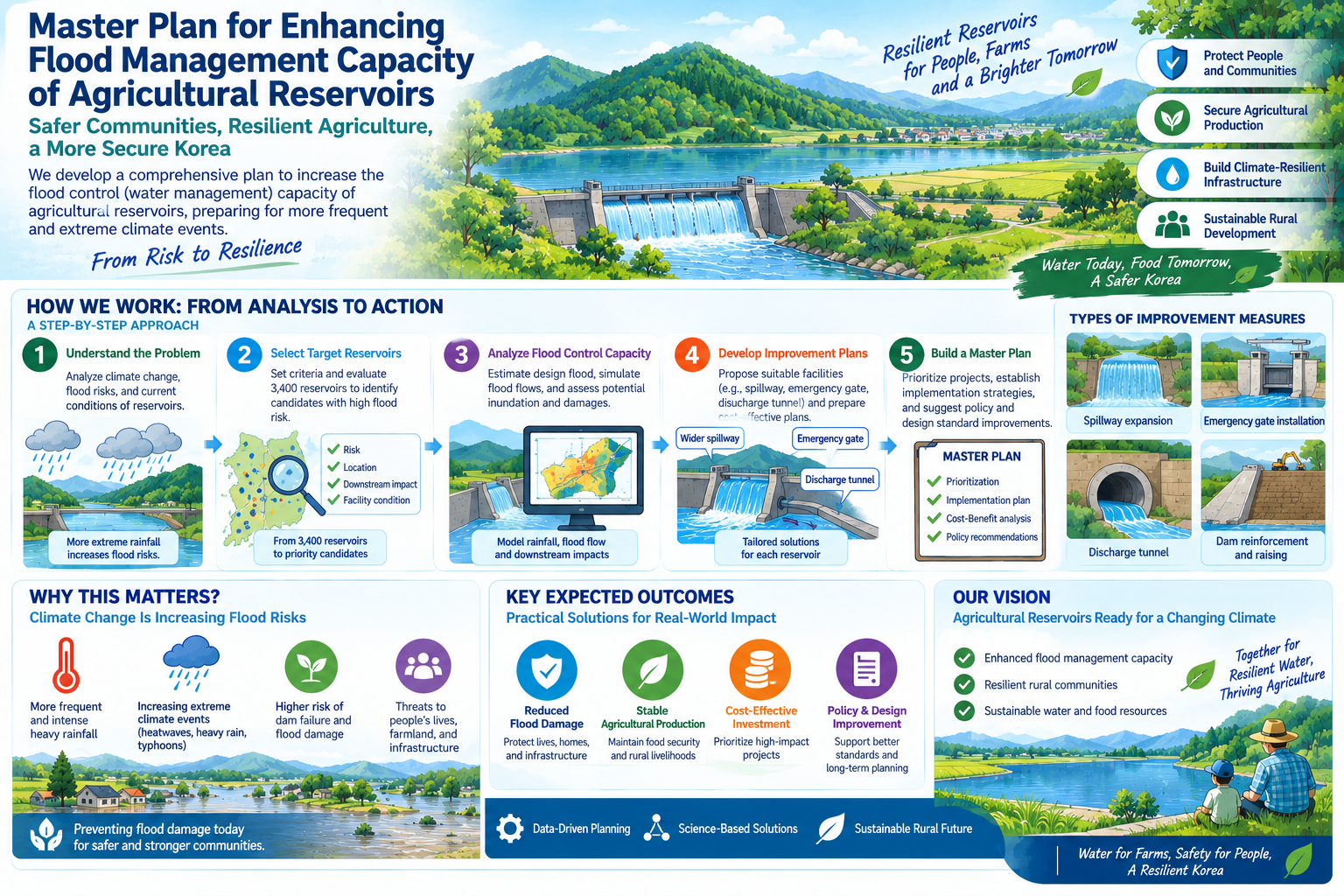
The core of the master plan is identifying priority sites and preparing concrete plans for them. The study set out a procedure for determining the appropriate flood control structures at each priority site and estimating their scale and approximate cost. Organised at the level of a feasibility study, this tells the corporation what needs reinforcing at each reservoir and at what cost, supporting decisions on programme priorities and budget.