
Climate Impact and Vulnerability Assessment for Agro-Environmental Ecosystems: Scenario Downscaling and Future Projections
In 2021 the Institute of Watershed Management (IWMI) produced the climate change scenario downscaling and future climate projection component of a Rural Development Administration study on climate impact and vulnerability in agro-environmental ecosystems.
A vulnerability assessment rests on a premise about how much will change. If the future climate data behind that premise is not available at regional scale, the conclusions cannot be applied regionally either. Global climate model output has a spatial resolution of hundreds of kilometres and does not match the units that agro-ecological work requires, so downscaling must come first.
IWMI collected observational records and global climate change scenario data, produced downscaled datasets, verified how well they reproduced past climate using extreme climate indices, and then projected future changes in climate characteristics. Extreme indices were chosen as the verification standard because mean values alone explain ecological responses poorly. Bioclim bioclimatic indices were also derived. Bioclim is a set of variables such as annual mean temperature, minimum temperature of the coldest month and rainfall seasonality that govern species distribution, and it serves as standard input to species distribution models.
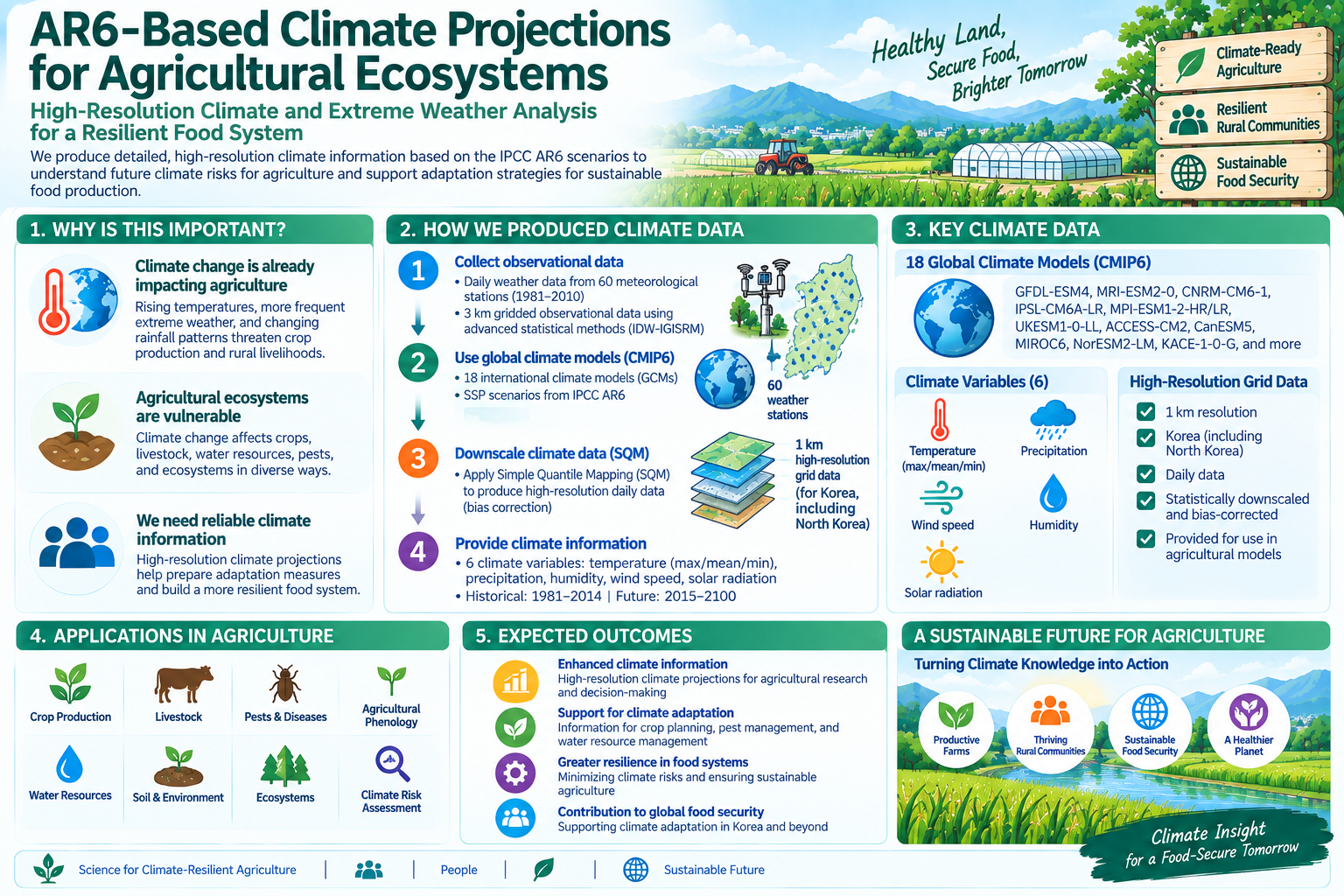
The downscaled data and bioclimatic indices fed directly into the impact and vulnerability assessment, providing the basis for analysing shifts in crop and species distribution at regional scale. Because climate data production and ecological assessment were carried out within the same study, the assumptions underlying the assessment results remain traceable.