
Linking Algal Bloom Forecasting with Water Pollution Incident Response Using Long-Range Weather Outlooks
The Institute of Watershed Management (IWMI) took part as a subcontracted institution in a study for the National Institute of Environmental Research on improving water quality forecasting and water pollution incident response. The work ran from 25 June 2021 to 22 March 2022, led by GeoSystem Research with AproSys as joint institution and ENGSoft, IWMI and Seoul National University of Science and Technology as subcontractors. IWMI’s component was improving the use of long-range weather outlook data.
Algal blooms depend heavily on water temperature, rainfall and flow. Long-range outlooks covering weeks to months ahead, rather than days, could therefore bring response time forward considerably. The obstacle is that long-range forecasts are produced in outlook form and carry large uncertainty, so they cannot be fed directly into water quality models. Operational use requires that both data format and uncertainty be addressed together.
IWMI reviewed the state of long-range forecast data from an operational standpoint and set out a roadmap for connecting it to algal bloom and water quality prediction. The roadmap works through which datasets can be relied on at which lead times, how they should be converted into the input form water quality models require, and how forecast uncertainty should be carried into the interpretation of results.
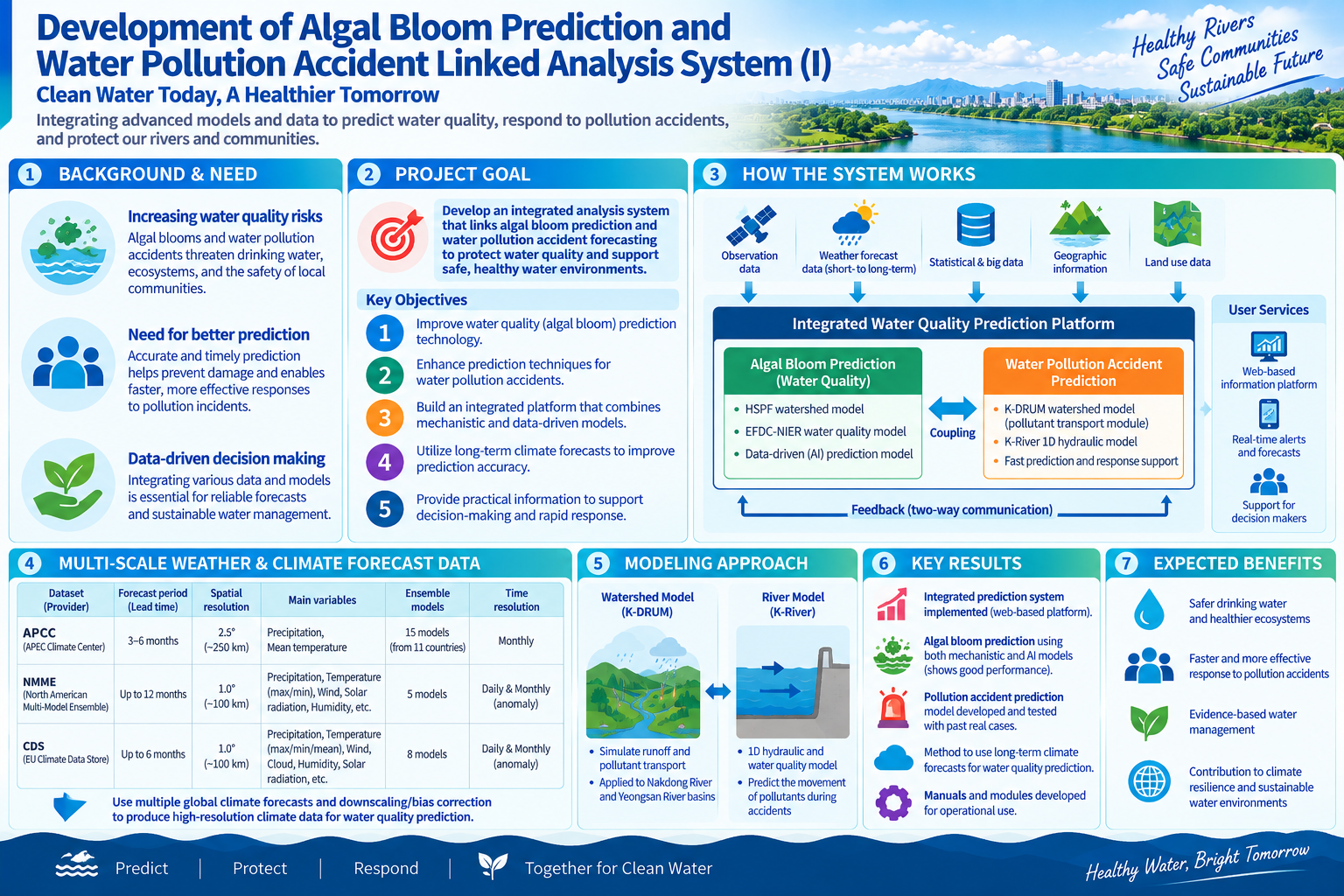
The first year of work brought water quality forecasting and pollution incident response prediction into a single analytical framework. It supplies the technical link needed to move from responding after an incident towards anticipating blooms and pollution events, and can be applied in the institute’s water environment forecasting work.