
Analysis and Information Production for Agro-Ecosystem Climate and Extreme Weather Based on AR6 Projections
The Institute of Watershed Management (IWMI) participated in a study analysing agro-ecosystem climate and extreme weather based on IPCC AR6 projections and producing climate information for agricultural use. Funded by the Rural Development Administration under its programme on predicting and assessing change in agricultural production environments, project number RS-2021-RD009055, the work was led by the National Institute of Agricultural Sciences with the University of Seoul research foundation as a joint institution. It ran for 48 months, from 1 January 2021 to 31 December 2024, with government funding of KRW 520 million.
Agriculture is among the heaviest users of climate information and yet among the least able to use standard projections directly. Crops respond to high and low temperatures at particular stages and to concentrated rainfall, not to mean temperature, and agricultural models require several daily weather variables at once. The project set out to build a system converting AR6 projections into information agriculture can actually use.
Work began with high-resolution observational data and the collection of AR6 scenario output. Modules producing single-variable downscaled data and climate indices were developed first, then extended to multi-variable detailed information and interfaces to agricultural models. Running such models requires variables such as temperature, rainfall and radiation to be mutually consistent, so downscaling each separately is not sufficient. A data format that agricultural models can read directly was also established.
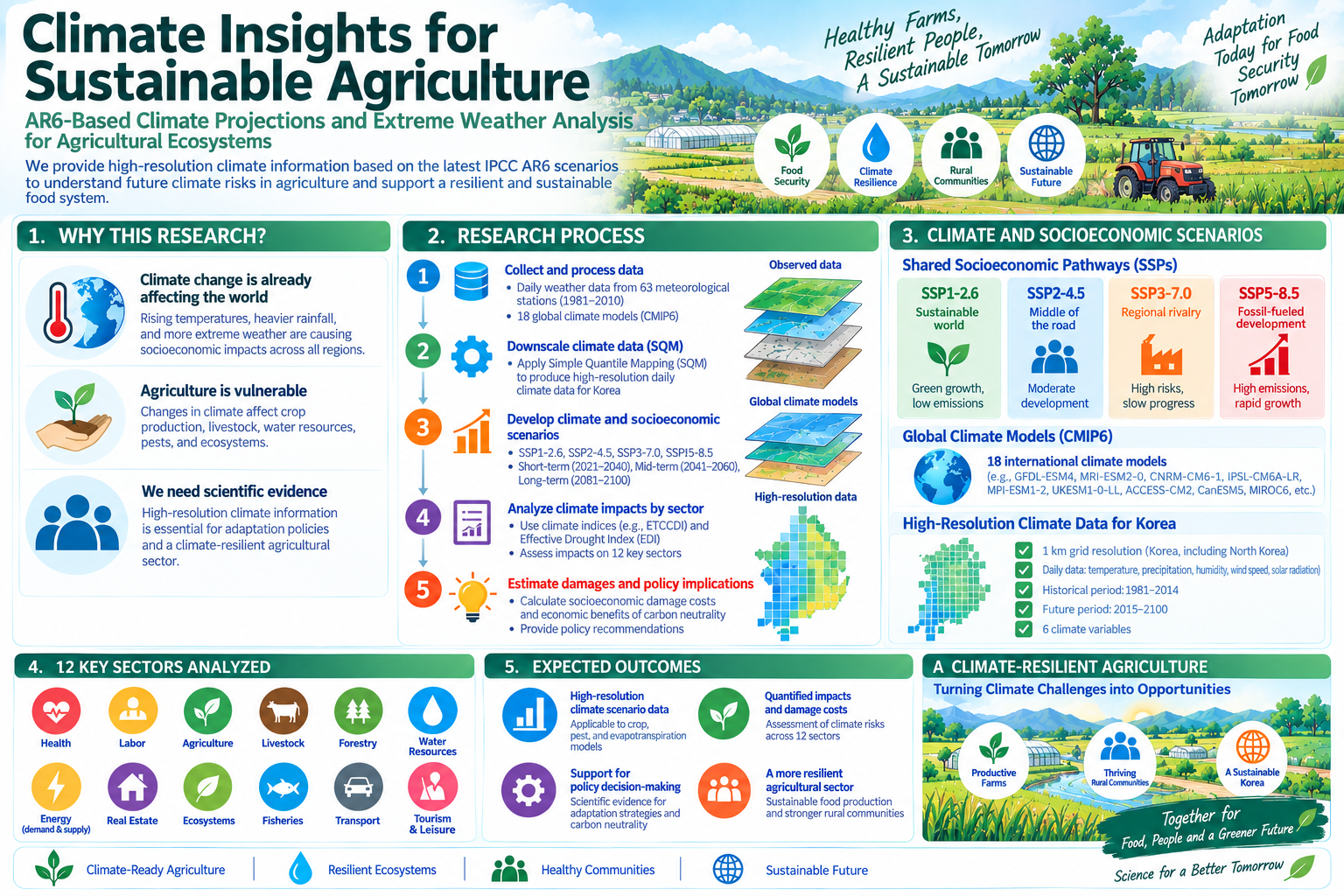
Four years of work produced a system generating high-resolution detailed climate information from AR6, together with projected changes in climate and extreme weather and in crop phenology. Shifts in phenology, the timing of flowering and ripening, bear directly on whether growing areas and farm calendars need to be reconsidered. The results can support the development of climate adaptation guidance for farming.