
Methodology and Guideline for Climate Change Impact Assessment in Rural Infrastructure Projects
In 2023 the Institute of Watershed Management (IWMI) developed a methodology and guideline for assessing climate change impacts in agricultural production infrastructure projects, commissioned by the Korea Rural Community Corporation.
Such projects build reservoirs, irrigation and drainage channels and land consolidation works that will be in service for decades. The rainfall and flow standards used in their design, however, generally rest on historical observation, and how climate change should be reflected was left to the judgement of individual project staff. When comparable projects use different scenarios over different periods, their results cannot be compared. The assignment set out to standardise that judgement.
The study first set out the structure of the IPCC assessment reports and the SSP climate change scenarios, and reviewed the state of domestic downscaled SSP datasets and nationally certified standard scenarios. It then established why multi-model ensemble projections are necessary: climate models differ in structure, so relying on one makes that model’s bias the conclusion, whereas using several allows the range of the projection to be stated. On this basis a database of downscaled data was built and analytical methods were defined.
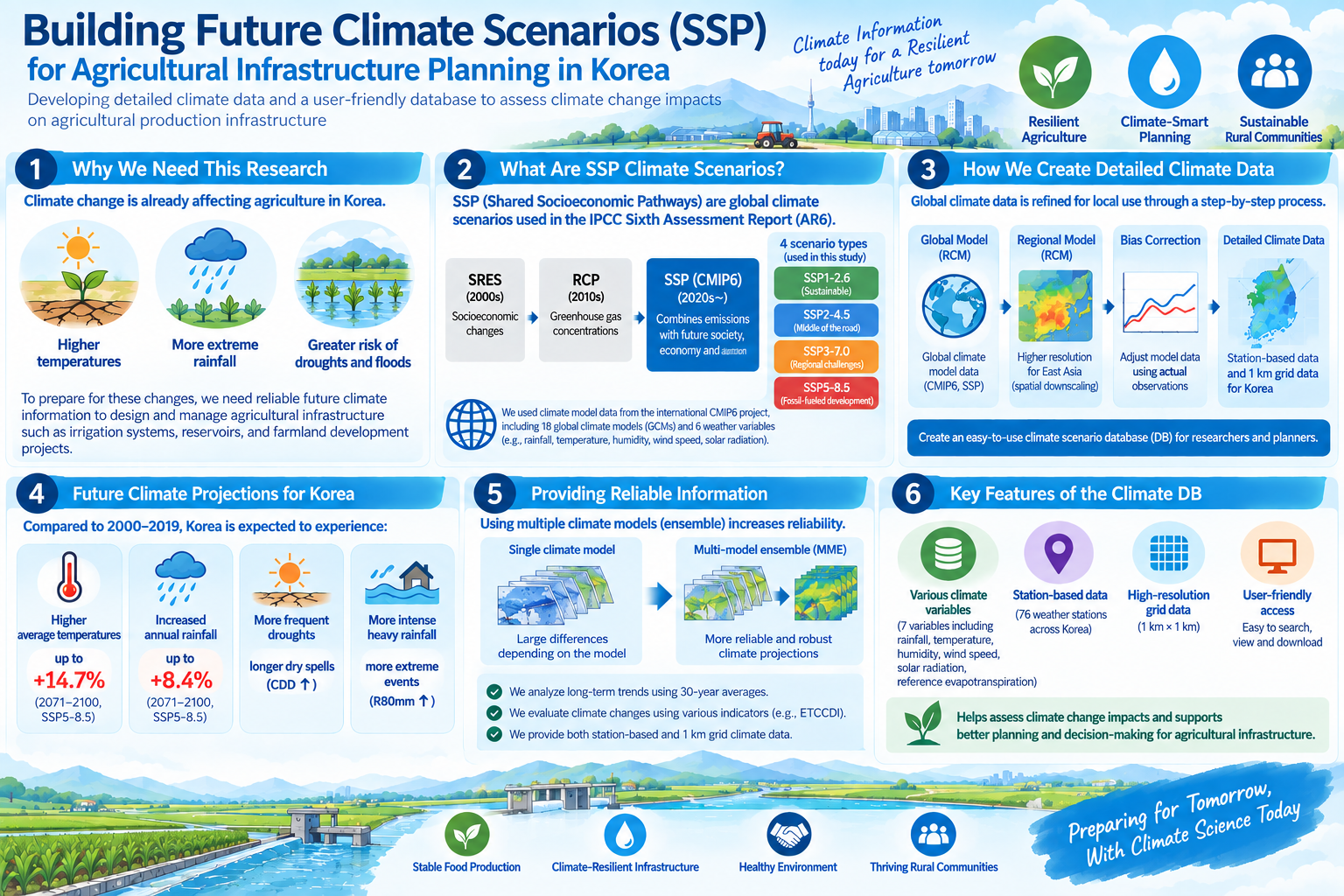
The final output is a guideline that project staff can follow directly. Fixing which scenarios and periods to use, where and how to obtain downscaled data, and how to express uncertainty makes projects comparable and places review and appraisal on a common basis. Turning climate response from individual discretion into procedure is the contribution of this work, and it applies across the corporation’s rural infrastructure programme.