
Climate Safety Assessment of Vulnerable Facilities Based on Climate Vulnerability Analysis
The Institute of Watershed Management (IWMI) took part in a study analysing the climate safety of vulnerable facilities based on climate change vulnerability assessment, commissioned by the Korea Rural Community Corporation. The Chonnam National University research foundation was the lead institution, with IWMI as a research partner. Work began on 3 May 2022 and ran for 235 days, with the final report delivered in December of that year.
Korea has tens of thousands of agricultural production infrastructure facilities. Knowing that climate change increases risk does not by itself determine what to address first, and the climate conditions and downstream exposure of each facility differ enough that a single uniform standard will not serve. What is needed is an index allowing facilities to be compared on the same basis for their safety against climate risk. This study defined and calculated that index.
The work began by establishing climate change conditions and projections, then designed a method for connecting vulnerability assessment results to individual facilities. Vulnerability is normally assessed by administrative area or catchment; translating it to facility scale requires treating both the climate exposure of the site and the sensitivity and adaptive capacity of the structure itself. A framework for calculating facility-level climate safety was established on this basis.
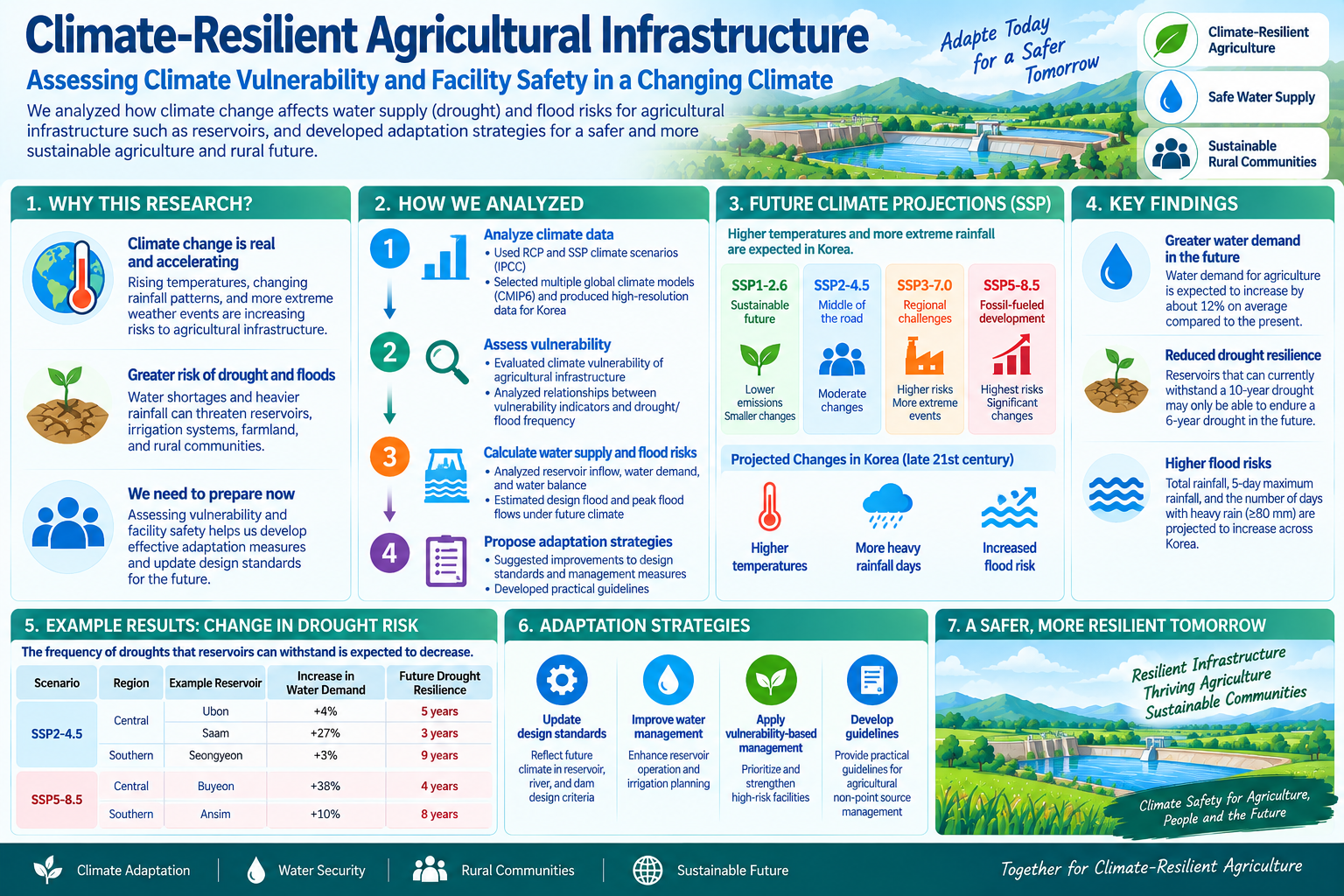
Once climate safety is quantified, facilities can be ranked, and ranking makes it possible to say where budget should go first. The results support the corporation in setting investment priorities for climate adaptation across its facilities and in selecting vulnerable structures for reinforcement. The study’s contribution is bringing climate projections into facility management in quantitative form.