
Downscaled Extreme Weather Data under SSP-RCP Scenarios for National Risk Management
The Institute of Watershed Management (IWMI) produced downscaled extreme weather data under SSP and RCP scenarios under contract to the Korea Environment Institute. The assignment ran for 183 days, from 15 April to 14 October 2021, with a contract value of KRW 15 million. It supplied the baseline data for the institute’s study on building and assessing national climate adaptation capacity through economic analysis of extreme climate risk.
Adaptation policy is decided by extremes rather than averages. How many additional days a heat wave lasts, or how much larger a daily rainfall maximum becomes, matters more for damage than a shift in mean temperature. Global climate model output, however, has a spatial resolution of hundreds of kilometres, from which regional extreme indices cannot be read directly. Economic analysis of extreme climate risk therefore requires downscaled data first.
IWMI generated downscaled data suitable for extreme weather analysis under both the SSP and the RCP scenario families. Both were treated because existing policy and research are built on RCP, while analysis following the IPCC Sixth Assessment Report assumes SSP. Only if results from the two can be compared on the same basis is it possible to connect accumulated adaptation research with newer projections.
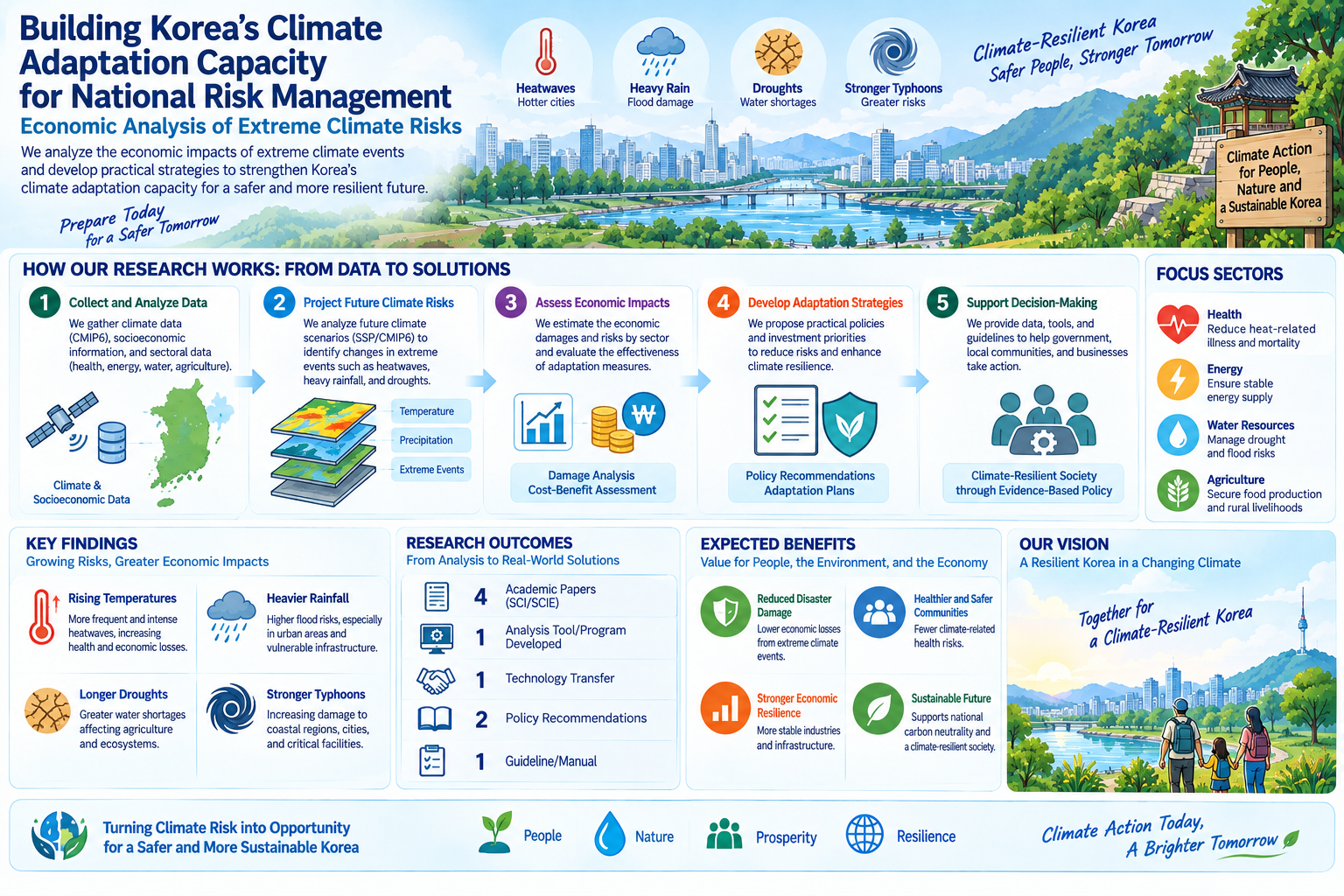
The data served as input to the economic analysis of extreme climate risk and underpinned the assessment of national adaptation capacity. The findings were published as a 2021 research report by the Korea Environment Institute. Having downscaled data capable of supporting extreme indices is the starting point for any subsequent analysis that seeks to express the effect of adaptation measures in monetary terms.