
Change in Ginseng Cultivation Suitability Using 1 km Downscaled SSP Data
The Institute of Watershed Management (IWMI) analysed changes in ginseng cultivation suitability using 1 km downscaled SSP data, under contract to the National Institute of Agricultural Sciences of the Rural Development Administration. The final report was delivered on 31 October 2022, with the analysis and data transferred to the institute as a basis for related research.
Ginseng is a demanding crop. It favours shade and tolerates summer heat poorly, so even a modest rise in temperature can render current production areas unsuitable. Its four to six year growing cycle matters too: once planted, a decision is not easily reversed. Knowing in advance where will remain suitable, and for how long, is therefore a practical question.
Two models were applied side by side. The first overlays the production area criteria established by the Rural Development Administration; the second is a MaxEnt species distribution model trained on actual occurrence locations. The former connects to existing administrative and technical standards, the latter reflects the conditions that observed distribution reveals, and reading the two together exposes the confidence range of any conclusion. Climate input came from 1 km resolution downscaled data under SSP scenarios, since a crop whose suitability depends on local terrain and shade cannot be resolved on a coarse grid.
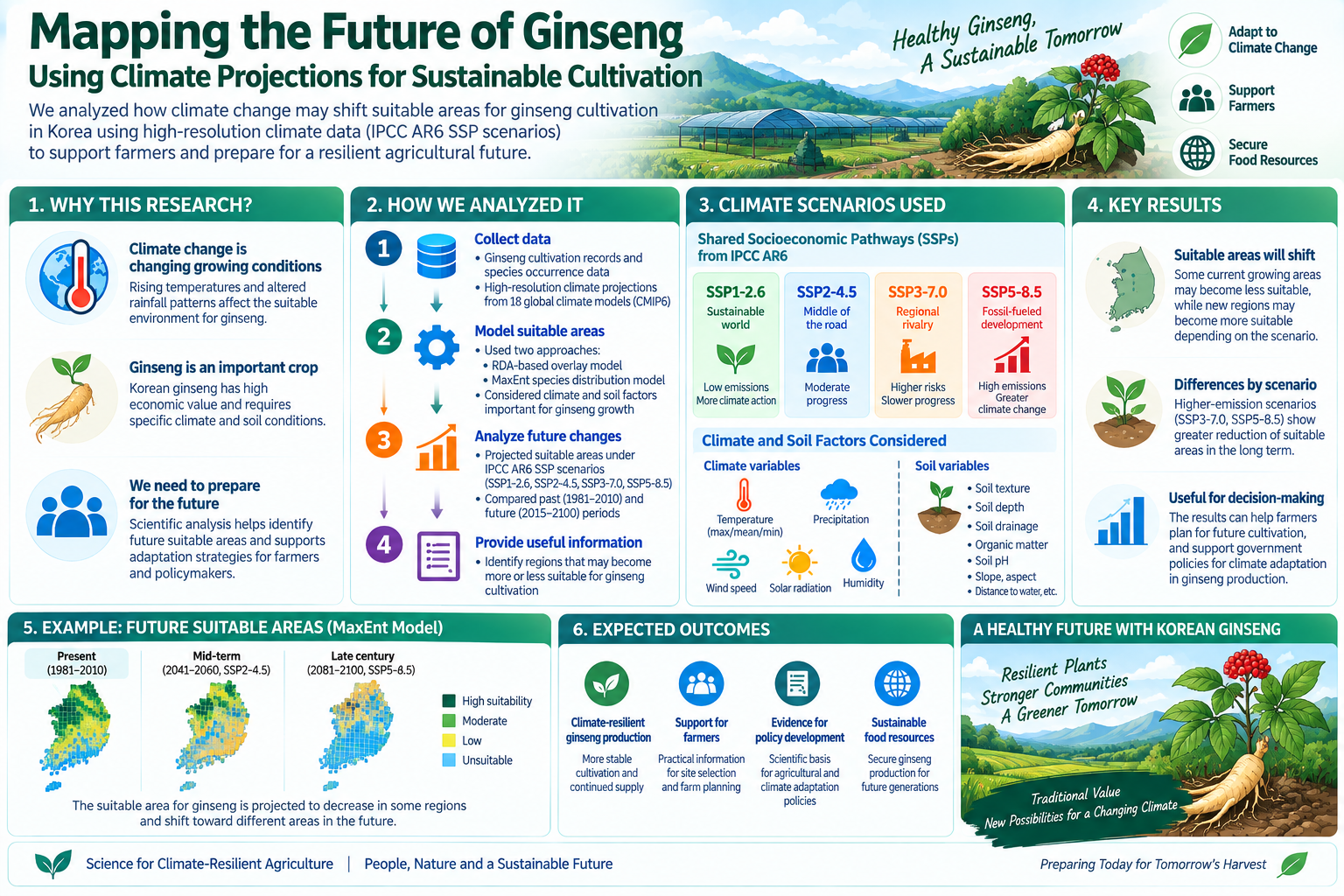
Suitability over a historical period was assessed to confirm model validity before projecting future change, and the MaxEnt analysis identified the environmental variables governing suitability. The results show on a map how far and in which direction suitable ginseng areas shift, supporting growers’ siting decisions and the preparation of climate adaptation guidance for farming.