
Long-Range Climate Forecasting for the Gyeonggi Agricultural Drought Prediction System
The Institute of Watershed Management (IWMI) developed the long-range climate forecasting component of the Gyeonggi Agricultural Drought Prediction System. The project was part of the 2019 Data Flagship Programme of the National Information Society Agency, led by the Gyeonggi Provincial Government with the Gyeonggi Agricultural Research and Extension Services, JBT Co. and the National Center for AgroMeteorology. It ran from 13 June to 20 December 2019, seven months, with a total budget of KRW 1 billion.
Between 2012 and 2017, cumulative May rainfall in Gyeonggi Province fell below 100 mm, about 40 per cent of the long-term average of 253 mm, in the month when demand for irrigation water is highest. Crop damage followed. Responding after drought damage appears is already too late, so the province needed a forecast base on which irrigation water could be allocated months in advance.
Long-range climate forecasting here does not mean predicting weather on a given day. It estimates whether monthly or seasonal averages will be above or below normal, up to six months ahead. The team used individual model forecasts collected worldwide and distributed by the APEC Climate Center. Probabilistic outlooks alone are difficult to use for drought analysis, so quantitative individual model output was selected instead. The monthly data, at roughly 250 km resolution, was downscaled and converted to daily values suitable for drought index calculation.
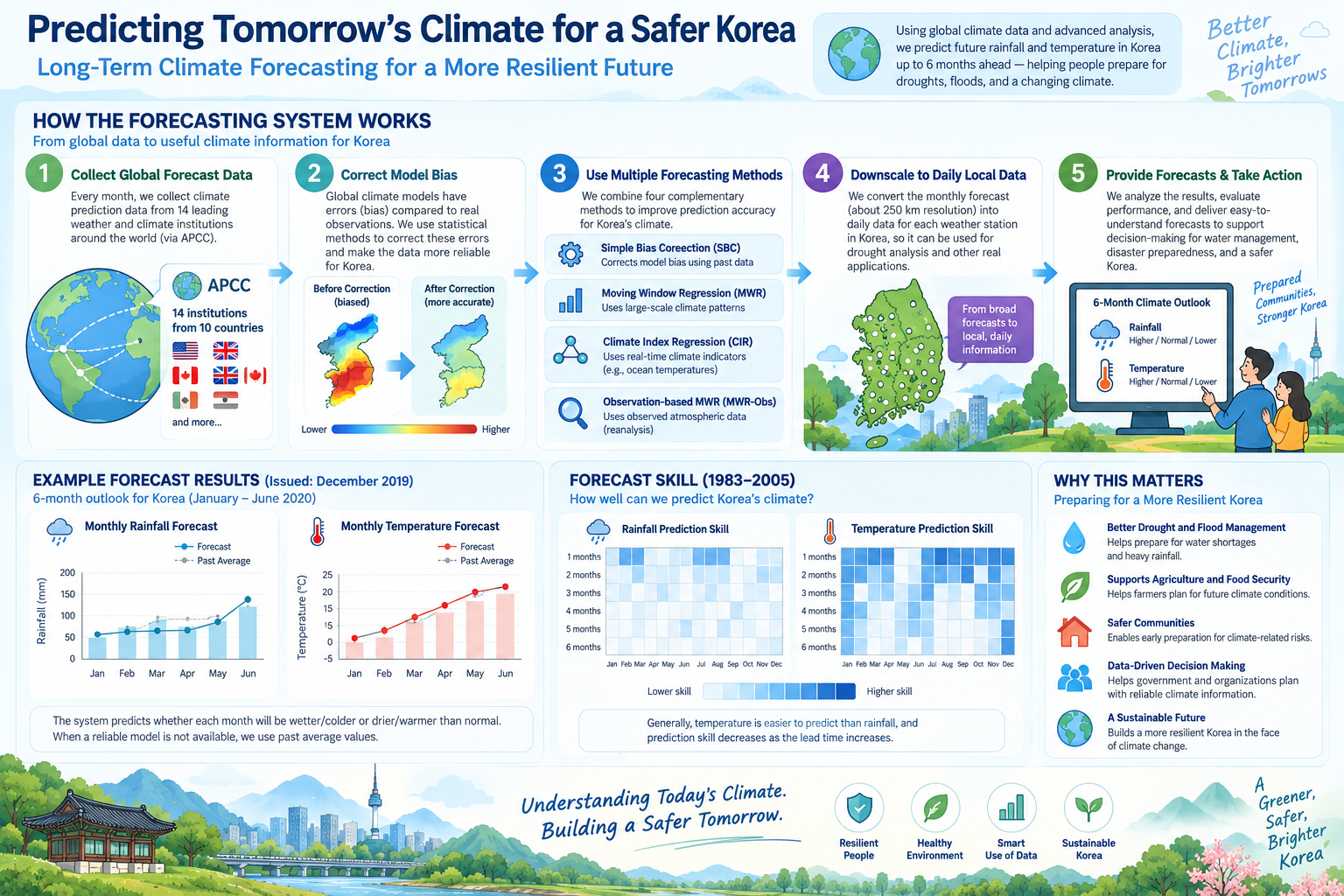
The model was designed to ingest monthly updates and produce operational outlooks, and was linked to the provincial drought prediction system. Results are intended for use by the provincial government, its agricultural research service and 31 local authorities, shifting drought response from post-damage recovery towards advance water management.