
Downscaled Climate Change Scenario Data Based on IPCC AR6
The Institute of Watershed Management (IWMI) produced downscaled climate change scenario data based on the IPCC Sixth Assessment Report, under contract to the National Institute of Environmental Research. The work plan was submitted in April 2021 and the final report in August 2021.
Managing catchments under integrated water resources management requires an evidence base for anticipating climate change. Projecting how climate and extreme weather will shift, and assessing what that means for catchment hydrology and water quality, is what allows potential water environment problems and their remedies to be identified in advance. The timing was significant: Korea’s second national climate adaptation plan had just concluded, a third was being prepared, and the IPCC Sixth Assessment Report was due in 2022. Where the RCP scenarios of the Fifth Assessment Report addressed greenhouse gas concentration alone, the SSP scenarios also account for socio-economic pathways, so the analytical basis needed to move.
The assignment produced downscaled SSP scenario data for the Korean peninsula. Global climate model output was downscaled against observations, verified for how well it reproduced past climate, and then used to generate future projections. Change was expressed through ETCCDI climate change indices and the Effective Drought Index, with the set of indices agreed with the client so that items relevant to water environment management were included.
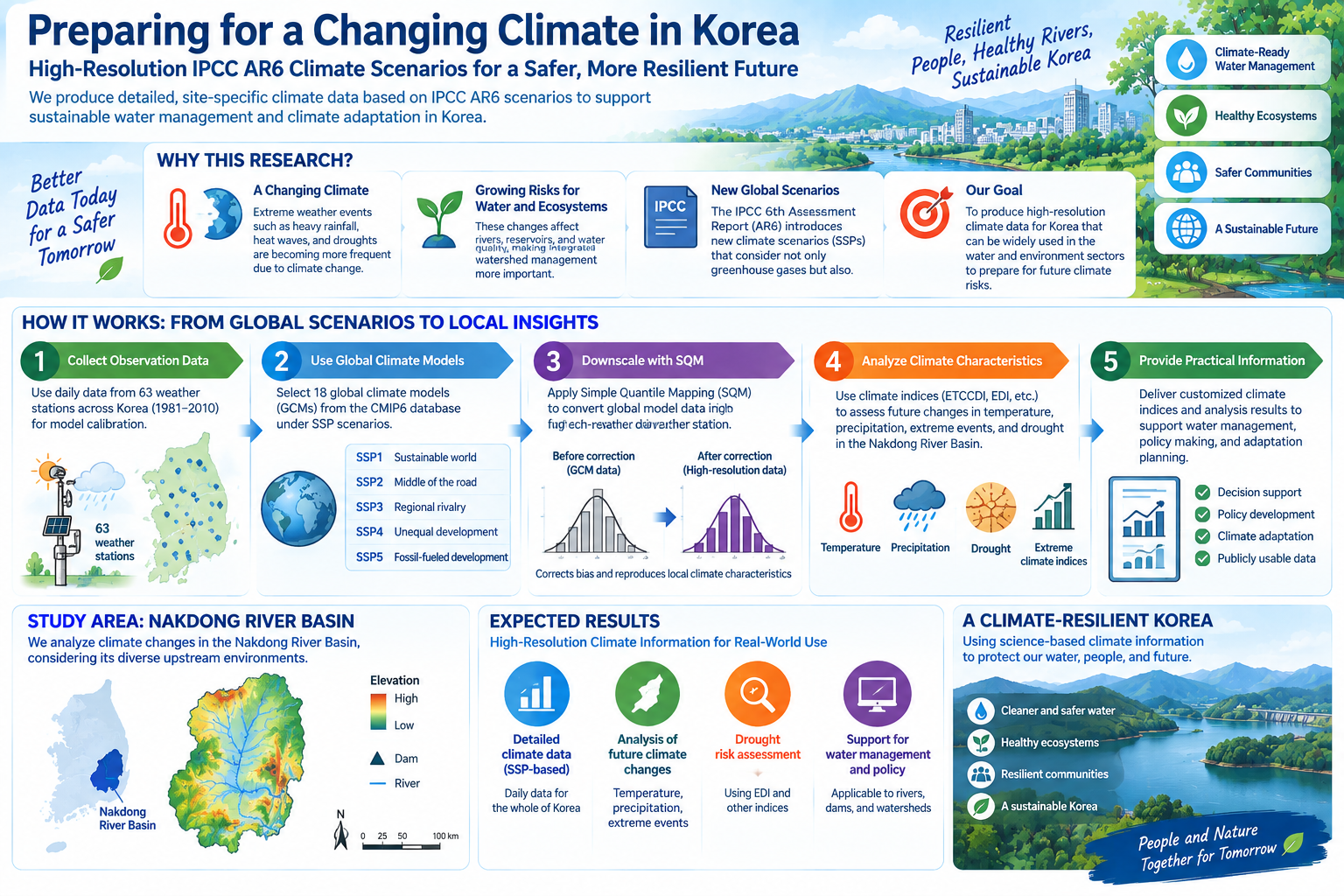
The resulting dataset can serve as input to catchment-scale hydrological and water quality impact assessment. Downscaled data are not a conclusion in themselves but the floor on which subsequent impact assessment stands, and this work laid the groundwork for shifting national adaptation planning onto an AR6 basis.