
A Living Lab Demonstration Model for Reducing Heat and Drought Damage
The Institute of Watershed Management (IWMI) participated as a joint research institution in a project to establish a demonstration model for reducing heat and drought damage to livestock, crops and water management, based on high-resolution multi-scale weather prediction and a living lab approach. Funded under the Rural Living Lab Project of the Ministry of Agriculture, Food and Rural Affairs and managed by the Korea Institute of Planning and Evaluation for Technology in Food, Agriculture and Forestry, it was led by the National Center for AgroMeteorology. The project ran from 29 April 2020 to 31 December 2022, two years and nine months, with a total budget of KRW 2.9 billion.
Heat waves and droughts pose a particular problem: a forecast does not translate by itself into what a farm should do. The step between meteorological information and on-farm decisions is missing. Rather than stopping at producing high-resolution forecasts, the project built a living lab in which stakeholders take part directly, turning prediction into field response.
IWMI led the water component. It built models for agricultural drought propagation and for agricultural water supply and demand, developed a living lab drought preparedness model for irrigation management, and assessed its applicability in the field. It also evaluated the skill of long-range high-resolution climate projections and developed a module linking them to impact forecasting, so that multi-scale climate information could be used in actual water management. Other partners developed a livestock heat stress warning system, a mobile decision support tool for crop growth and a regional impact forecasting service.
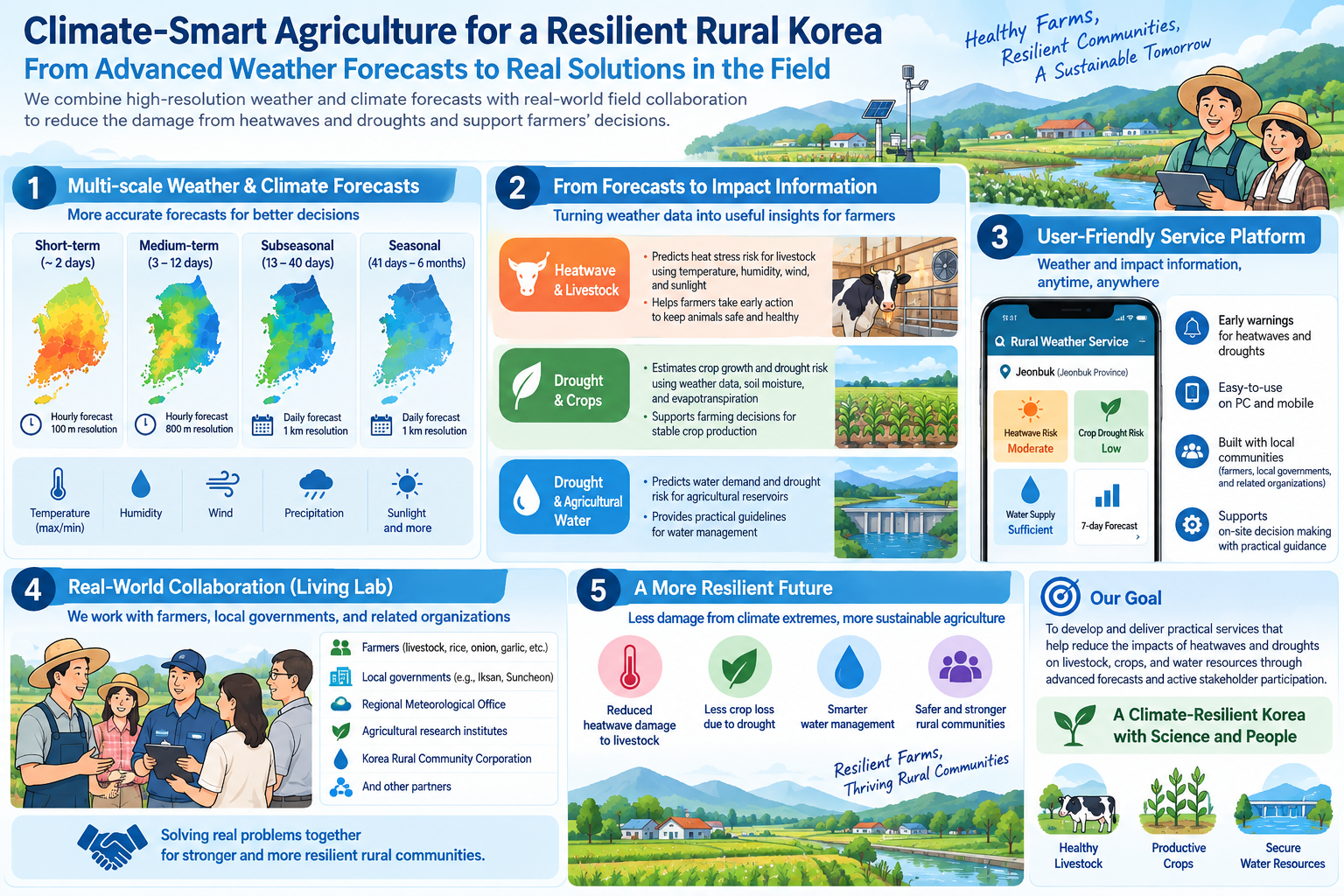
The project’s contribution lies in placing forecast producers and farm users within a single system. The participatory impact forecasting service and the drought preparedness irrigation model demonstrate pre-emptive response rather than post-damage recovery, and offer a reference for local authorities designing region-specific measures.