
Agricultural Water Management under Integrated Water Resources Management in the Nakdong River Basin
The Institute of Watershed Management (IWMI) conducted a study on scientific agricultural water management under integrated water resources management in the Nakdong River basin, commissioned by the Korea Rural Community Corporation and carried out from 25 August to 31 December 2020.
Korea’s Framework Act on Water Management had merged the previously separate quantity and quality regimes, and a national water management plan and basin-level plans were being prepared in sequence. Agricultural water accounts for a large share of total use, yet there was little established basis for treating it within basin-scale planning. The study reviewed the agricultural water issues raised in national water policy forums and proposed both an institutional structure and the technical methods needed to manage agricultural water at basin scale.
The work followed three tracks. First, it proposed a demand-led management structure and supporting organisational arrangements at standard sub-basin scale. Second, to manage quantity and quality together, 458 agricultural reservoirs in North and South Gyeongsang provinces were surveyed and representative water sources selected using criteria including monitoring access, availability of national gauging networks and simplicity of the irrigation and drainage network. Monitoring was extended from individual fields to the reservoir command area, and the method for estimating paddy water requirements was revised. Third, disaster case studies informed continuous monitoring techniques and safety management measures for ageing irrigation structures.
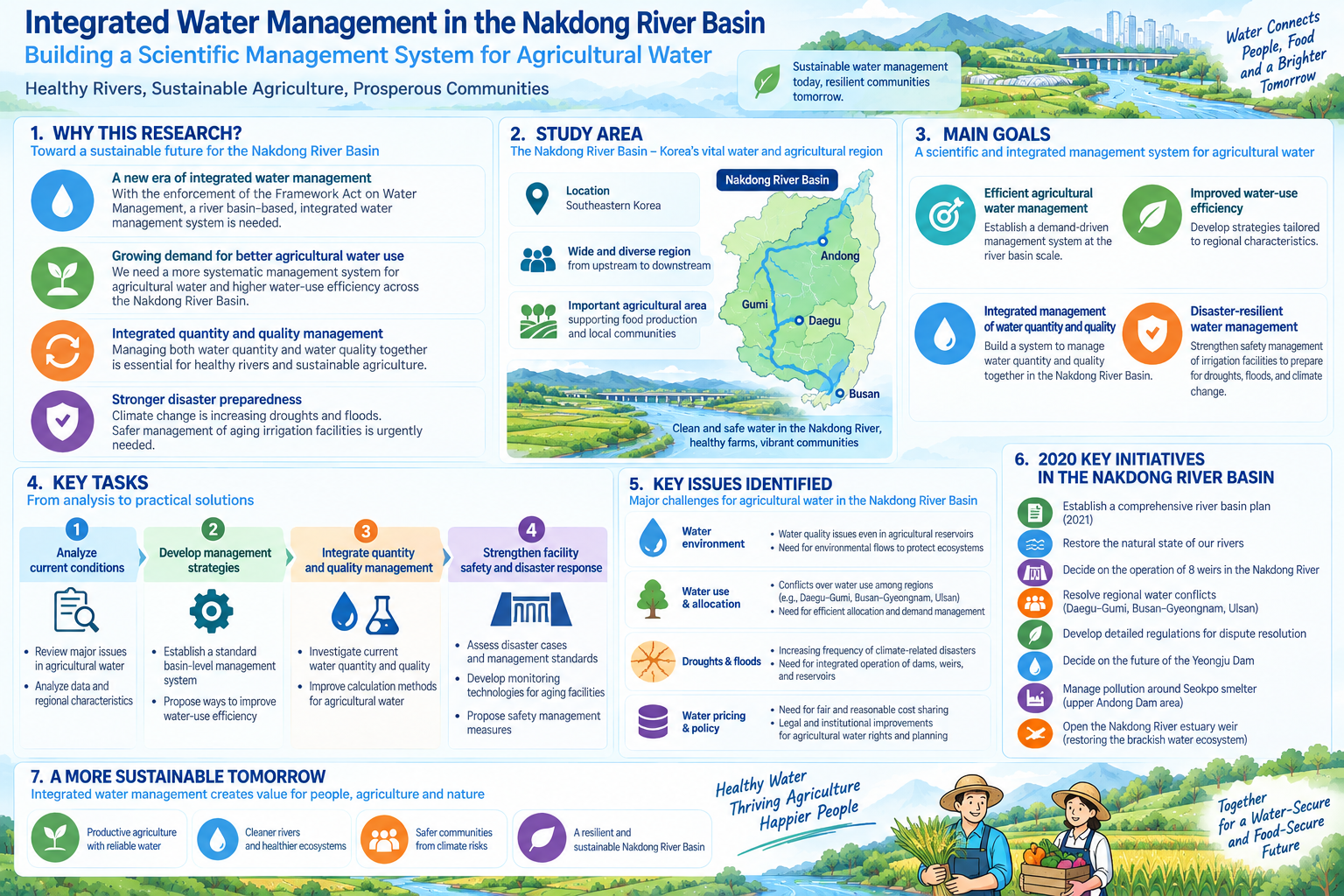
The surveyed reservoirs averaged 123 ha of command area, 962,000 cubic metres of effective storage and a catchment ratio of 7.8, indicating generally stable supply capacity. However, many of the 1,334 reservoirs in the basin are more than 50 years old, leaving disaster preparedness as a distinct challenge. The estimation methods and ageing-structure management criteria proposed here can support the inclusion of agricultural water in basin water management plans.