
Carbon-Neutral Forest Restoration Using Native Species: Mountain Climate Downscaling
The Institute of Watershed Management (IWMI) contributed mountain climate change downscaling to a research project on carbon-neutral forest restoration technology using native species. The project, number RS-2022-KF002047, fell under a national programme on forest sector carbon neutrality and demonstration technology. It ran from 1 April 2022 to 31 December 2024, two years and nine months, with a total budget of KRW 711 million.
Forests are counted as the largest carbon sink in neutrality planning, yet how much they absorb depends on how they change. Forest change in turn depends on climate, and mountain climate differs sharply from that of lowlands. A modest change in elevation separates temperature and rainfall regimes, so projecting mountain futures from lowland station records produces errors. The project addressed this through downscaling, and built forest succession and carbon uptake prediction on top of it.
IWMI’s downscaling work was grid-based. CMIP6 climate change scenarios were downscaled to a 100 metre grid, and mountain climate change was predicted and analysed on the same grid. The data served two purposes: a model predicting areas at risk of forest degradation in future periods, built on a forest vulnerability assessment methodology; and forest succession prediction using the downscaled scenarios, from which carbon uptake was estimated.
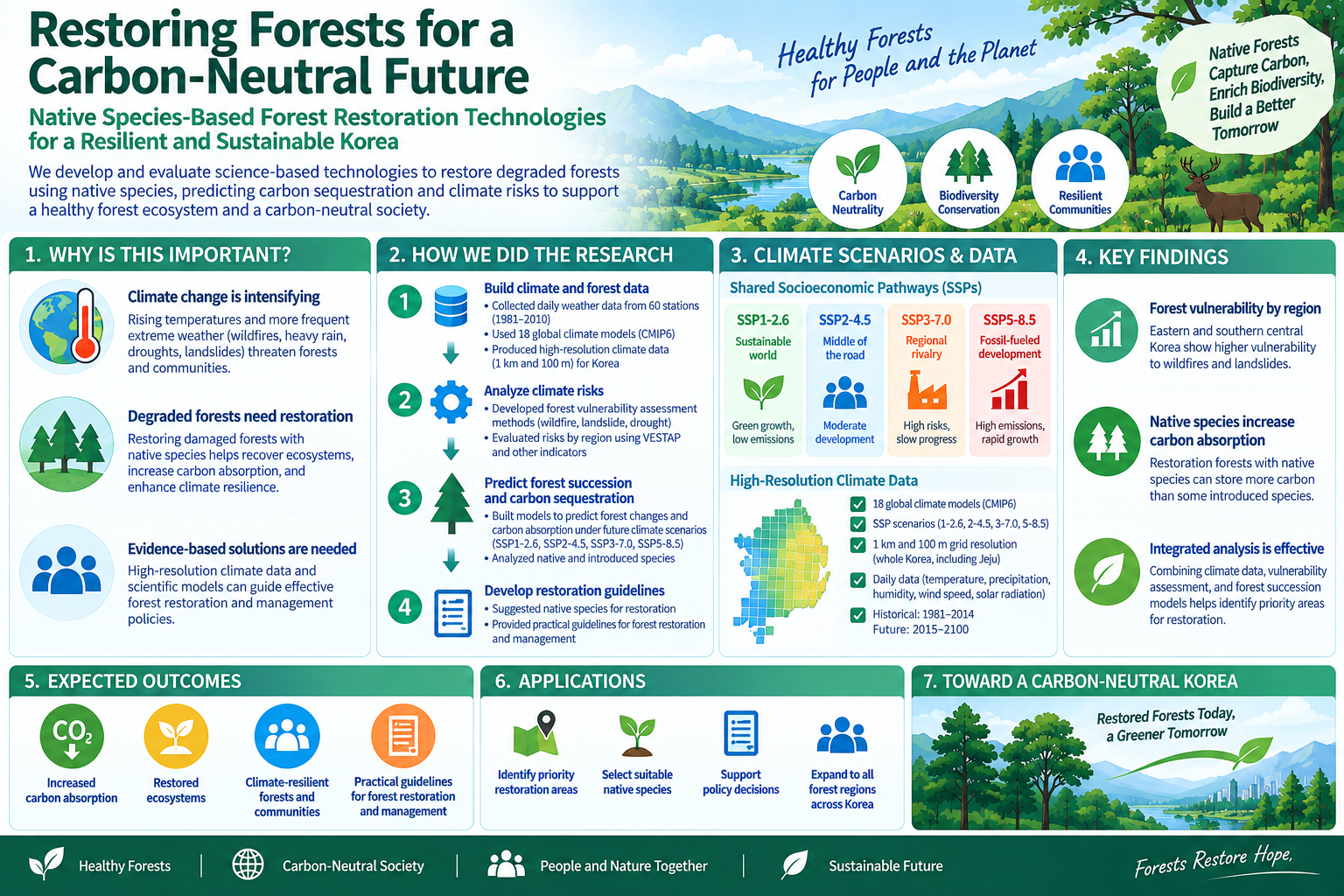
Alongside succession prediction, the project developed a process for assessing whether restoration plans align with national biodiversity objectives. Judging restoration by carbon uptake alone tends to favour fast-growing monocultures; requiring native species and biodiversity alignment is the deliberate design of this project. The results can inform forest restoration planning and carbon uptake accounting for the forest sector.