
Impact and Vulnerability Assessment of Nutrient Discharge from Farmland under Climate Change
The Institute of Watershed Management (IWMI) took part as a joint research institution in Phase I of a project assessing the impact of climate change on nutrient discharge from agricultural areas and the resulting vulnerability. The project was funded by the Rural Development Administration under its programme on predicting and assessing change in agricultural production environments, with project number RS-2020-RD009348. The National Institute of Agricultural Sciences led the work, which ran from 1 January 2020 to 31 December 2023, four years, with a total budget of KRW 727 million. Notesquare Co. was also a partner.
Nitrogen and phosphorus leaving farmland are major non-point sources governing the water quality of rivers and reservoirs. The difficulty is that discharge depends heavily on the intensity and timing of rainfall. As climate change alters rainfall patterns, the same farming practice yields different quantities of nutrients at different times. The project set out to quantify that shift by region, so that the vulnerability of particular farmland could be stated with evidence.
Future weather conditions derived from climate change scenarios were used to simulate nutrient discharge at field scale, and the results were organised into an impact and vulnerability assessment framework. IWMI was responsible for watershed and farmland modelling and for downscaling climate scenarios, while the partner institution handled data processing and the information system so that results could be used in the field and in policy.
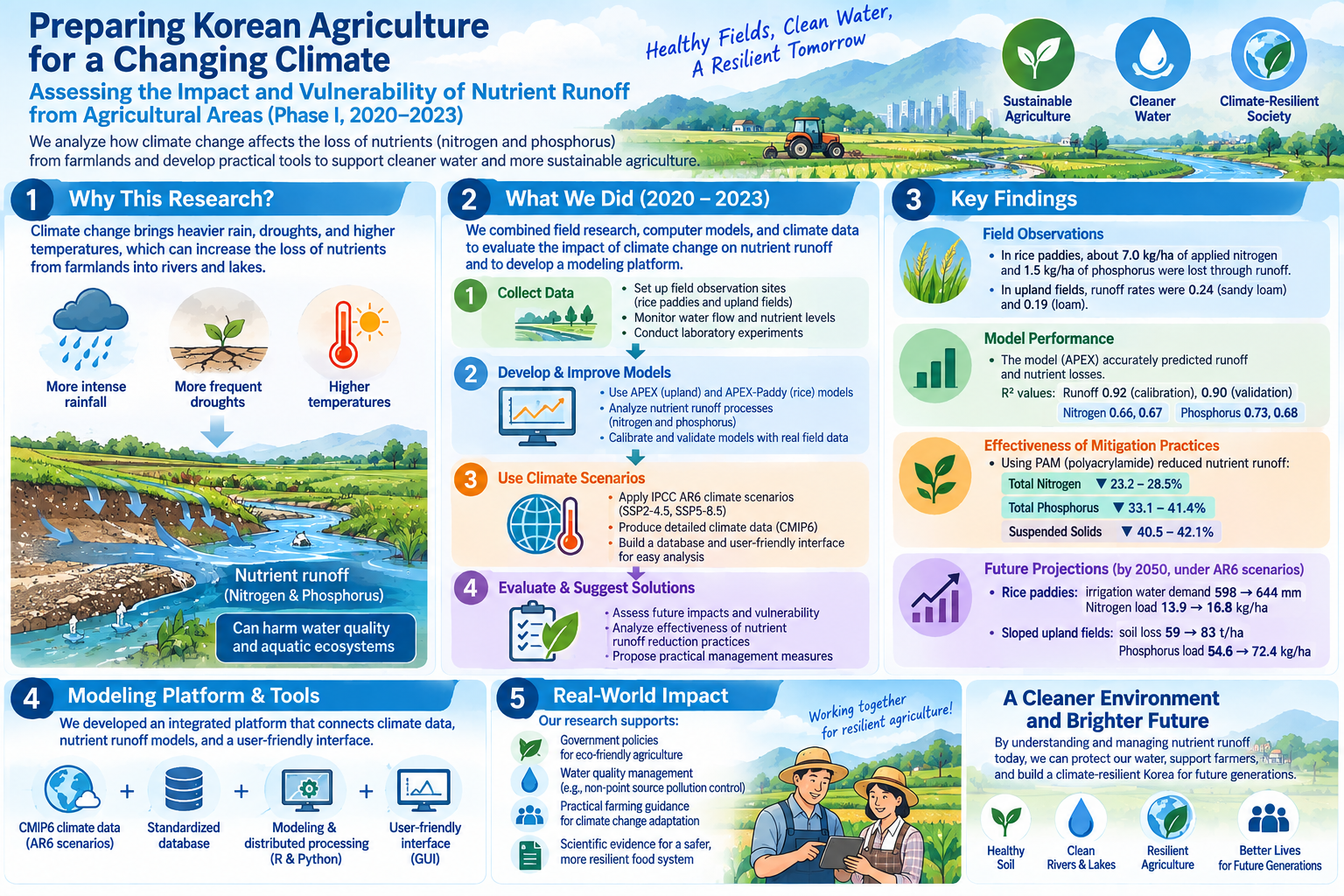
Four years of Phase I work established a basis for quantifying how climate change affects nutrient discharge from farmland. The results can support the Rural Development Administration and local authorities in designing non-point pollution measures and in adjusting cultivation and fertiliser management as an adaptation measure. Treating water quality and agricultural production within a single analytical framework, rather than separately, is the study’s main contribution.