
Non-Point Source Discharge Characteristics and Reduction Measures for Saemangeum Agricultural Land
The Institute of Watershed Management (IWMI) conducted a study on non-point source discharge characteristics and reduction measures for the Saemangeum agricultural land, commissioned by the Rural Research Institute of the Korea Rural Community Corporation. The work ran over three years, from 8 July 2022 to 30 November 2024, extending a 2021 study on discharge monitoring and modelling.
The Saemangeum agricultural land is being developed to support agricultural enterprises and the regional economy, with completion scheduled for 2027. As the land use plan diversifies from paddy towards upland and horticultural crops, upland conversion is proceeding, and upland fields do not impound water, so pollutant loads fluctuate considerably with farm management and weather. Reclaimed soil, built up from dredged material, also behaves differently from ordinary farmland. Without measuring what actually happens in the field, reduction measures could not be designed.
Small test plots were established at the Saemangeum agricultural research complex in block 6-1 and large plots in block 5, each with monitoring systems operated and maintained over three years. Soil loss from reclaimed soil and pollutant loads under large-scale farming were measured directly, with four survey campaigns during the study period. Because block 6-1 had not yet been completed, dredged fill depth was derived from the difference between rasterised original and finished ground levels to supplement model input.
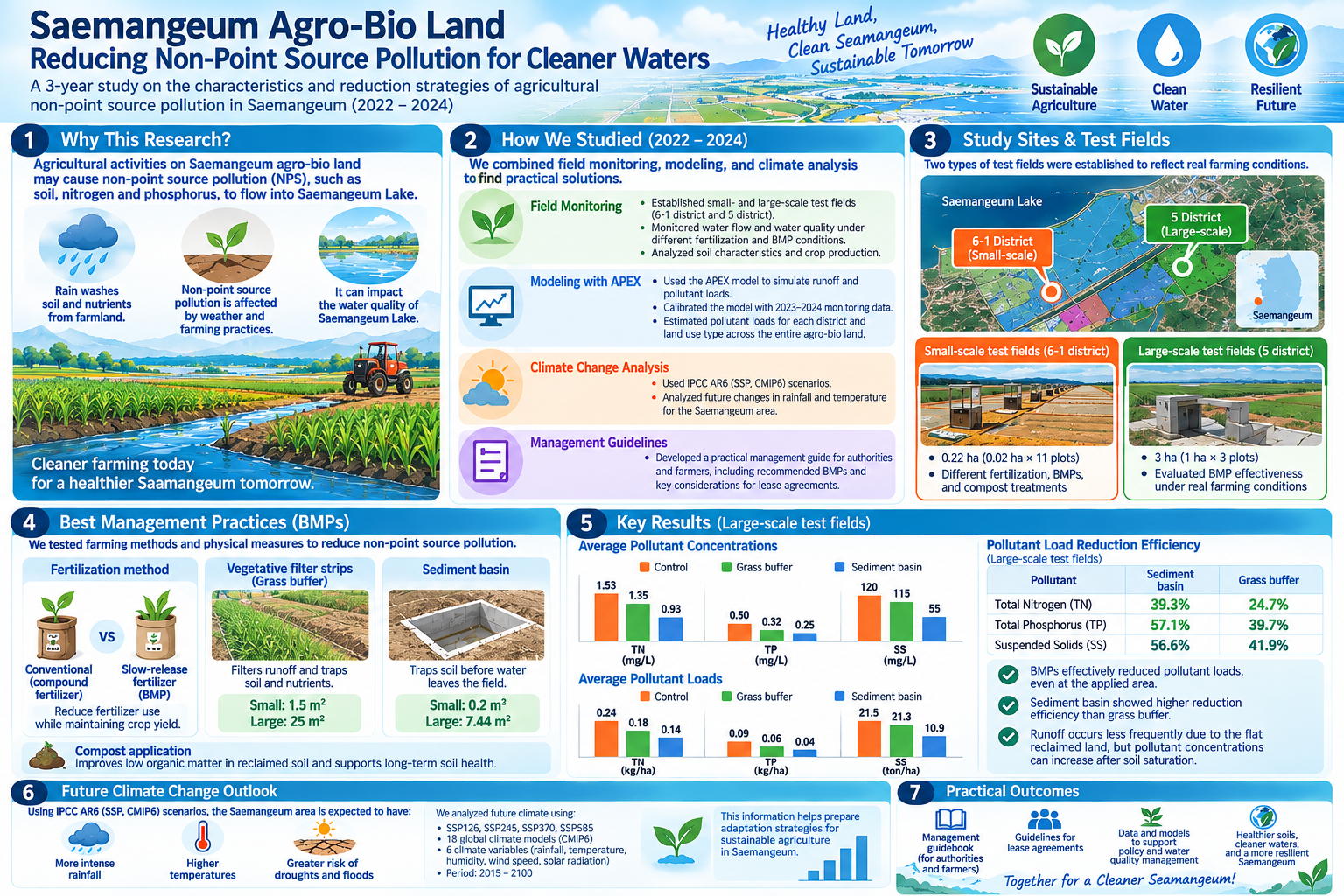
Three years of field monitoring provided the basis for characterising non-point source discharge under Saemangeum reclamation conditions and for deriving reduction measures. With construction continuing to 2027, establishing discharge characteristics before completion allows the findings to be reflected in the design of remaining blocks and in cultivation guidance. The results feed into water quality planning for the site.