
Downscaling AR6 Climate Change Scenarios for Seoul
The Institute of Watershed Management (IWMI) developed downscaled climate change scenarios for Seoul based on the IPCC Sixth Assessment Report, under contract to the Seoul Institute of Technology. The work began on 26 January 2022 and ran for 240 days, with a contract value of KRW 49.4 million. The findings were published as institute research report 2022-SR-07.
Urban climate measures cannot be built on national averages. Flooding, heat waves and the urban heat island all occur locally, and the infrastructure that responds to them stands in specific places. AR6 climate change scenarios, however, are global model output at a spatial resolution that does not match the scale of a city. Downscaling was needed to put them in a form Seoul could use.
Work began with observations. Daily rainfall and temperature records for Seoul weather stations were collected from the national meteorological portal, and long-term records from the three stations needed to compute a city average were combined using Thiessen polygons. Forty years of synoptic station data, from 1981 to 2021, established changes in rainfall, maximum and minimum temperature, wind speed and solar radiation. Future projections from 18 global climate models were then extracted from NetCDF files at station coordinates, and statistical quantile mapping was applied to produce station-scale future weather data.
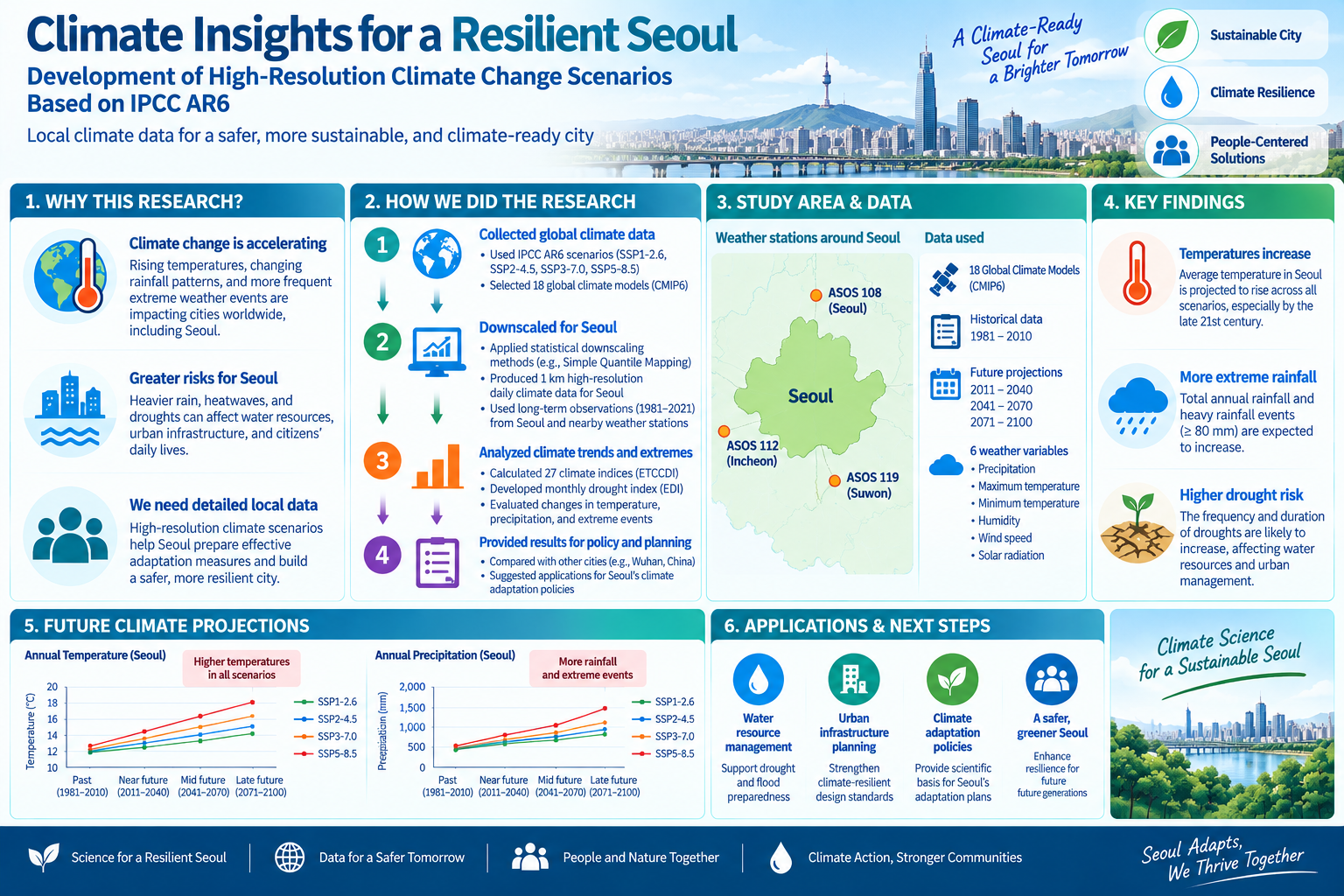
Eighteen models were used together because relying on one would carry that model’s bias straight into the projection. Placing several results side by side is what allows the range of the projection, its uncertainty, to be stated alongside it. The downscaled data can serve as climate input for Seoul’s flood and heat response planning and for reviewing design standards for urban infrastructure.