
Performance Verification and Institutionalisation for Seoul's LID Facilities
The Institute of Watershed Management (IWMI) conducted a study on commissioning and post-construction performance verification for low impact development facilities in Seoul, publishing its research report in August 2026. The focus is a performance management system built on monitoring of buried infiltration facilities.
Low impact development lets rainwater soak into the ground where it falls rather than running off, reducing flooding and non-point source pollution. Seoul has required such facilities in development projects through its pre-consultation system. The difficulty comes afterwards. Once designed and built, there was little procedure for confirming that a facility actually absorbs water as designed. Buried infiltration facilities in particular cannot be seen, so clogging goes unnoticed.
The study reviewed domestic practice in commissioning inspection and post-construction monitoring, then compared overseas systems. Philadelphia manages performance through commissioning documentation combined with observation wells. Washington D.C. keeps as-built drawings and facility self-inspections as an electronic record. Portland and Montgomery County set maintenance standards with re-inspection by the authority, and Prince George’s County ties construction performance bonds to commissioning approval. How verification is embedded in the regulatory process differs in each case.
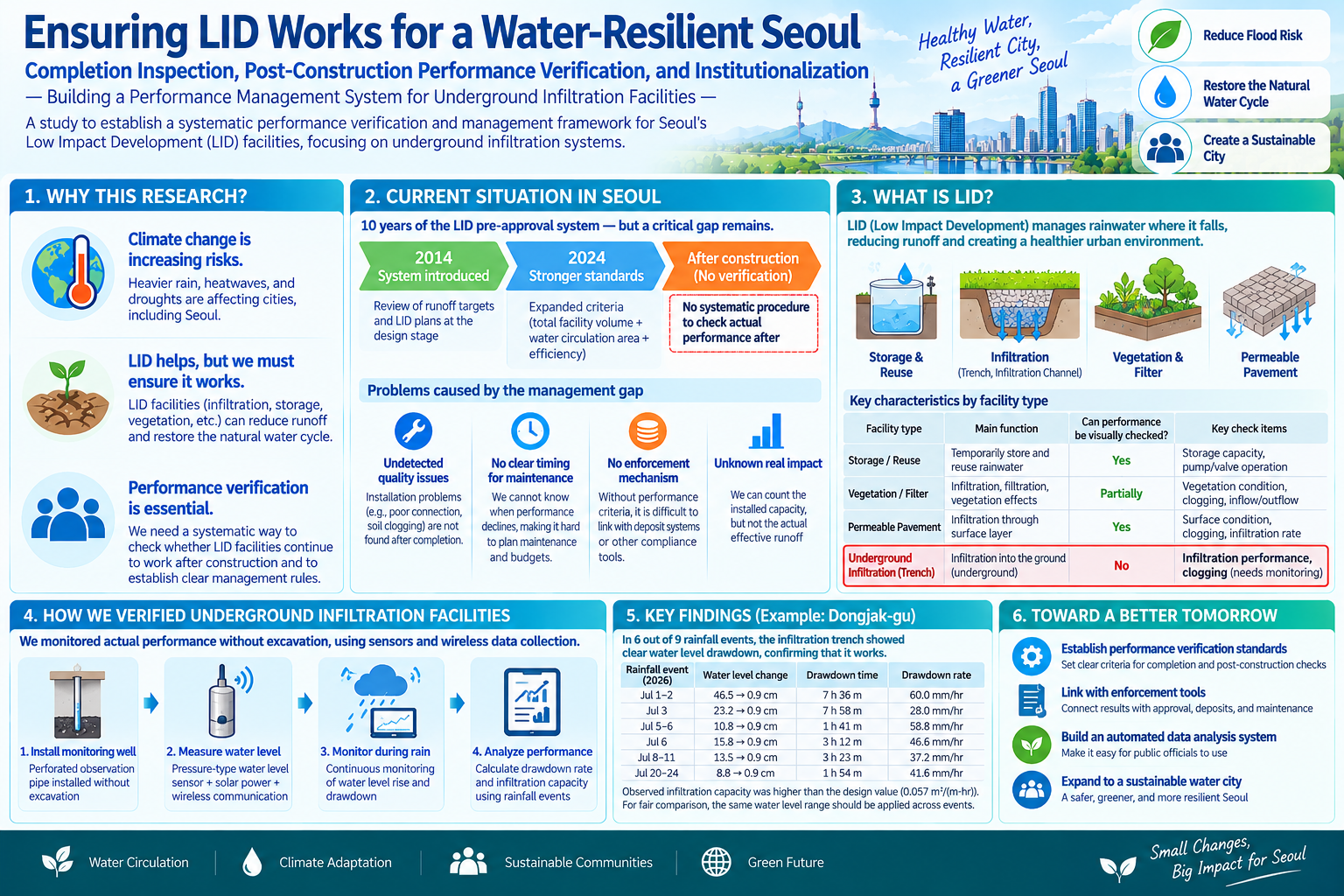
The study proposes a performance assessment framework by facility type and establishes a clean water injection test measuring infiltration performance at commissioning, together with a procedure for registering the result as baseline performance. Only if initial performance is on record can a later measurement be judged as degradation. The applicability and limits of commissioning inspection and post-construction monitoring are also set out, clarifying what is feasible and what remains open as Seoul moves LID performance management into regulation.