
Smart Integrated Forest Resource Management under Environmental Change
The Institute of Watershed Management (IWMI) took part in a research project on smart integrated forest resource management through prediction of forest ecosystems and of hydrology and water quality under environmental change. Funded by the Korea Forest Service, it was led by Chungnam National University with Dankook University. It ran from 1 April 2021 to 31 December 2023, two years and nine months, with a budget of KRW 795 million.
Forests are the largest regulator of water in a catchment, and they also change in response to climate and land use. As forest composition shifts, so do evapotranspiration, interception and soil infiltration, and with them the quantity and quality of water reaching downstream. Forest and basin water management have nonetheless usually been handled separately. The project joined forest succession prediction with catchment hydrology and water quality simulation, creating a basis for managing forest resources as one system.
IWMI was responsible for forest succession and catchment water yield prediction. CMIP6 climate change scenarios were downscaled for the target forest catchments, and a technique was developed to generate daily mountain weather data on a 100 m grid. Mountain weather varies sharply with elevation and terrain, so station records alone are difficult to use for catchment simulation. An integrated hydrology and water quality model incorporating forest ecosystem change was then developed to analyse how vegetation and land cover change affect mountain catchments.
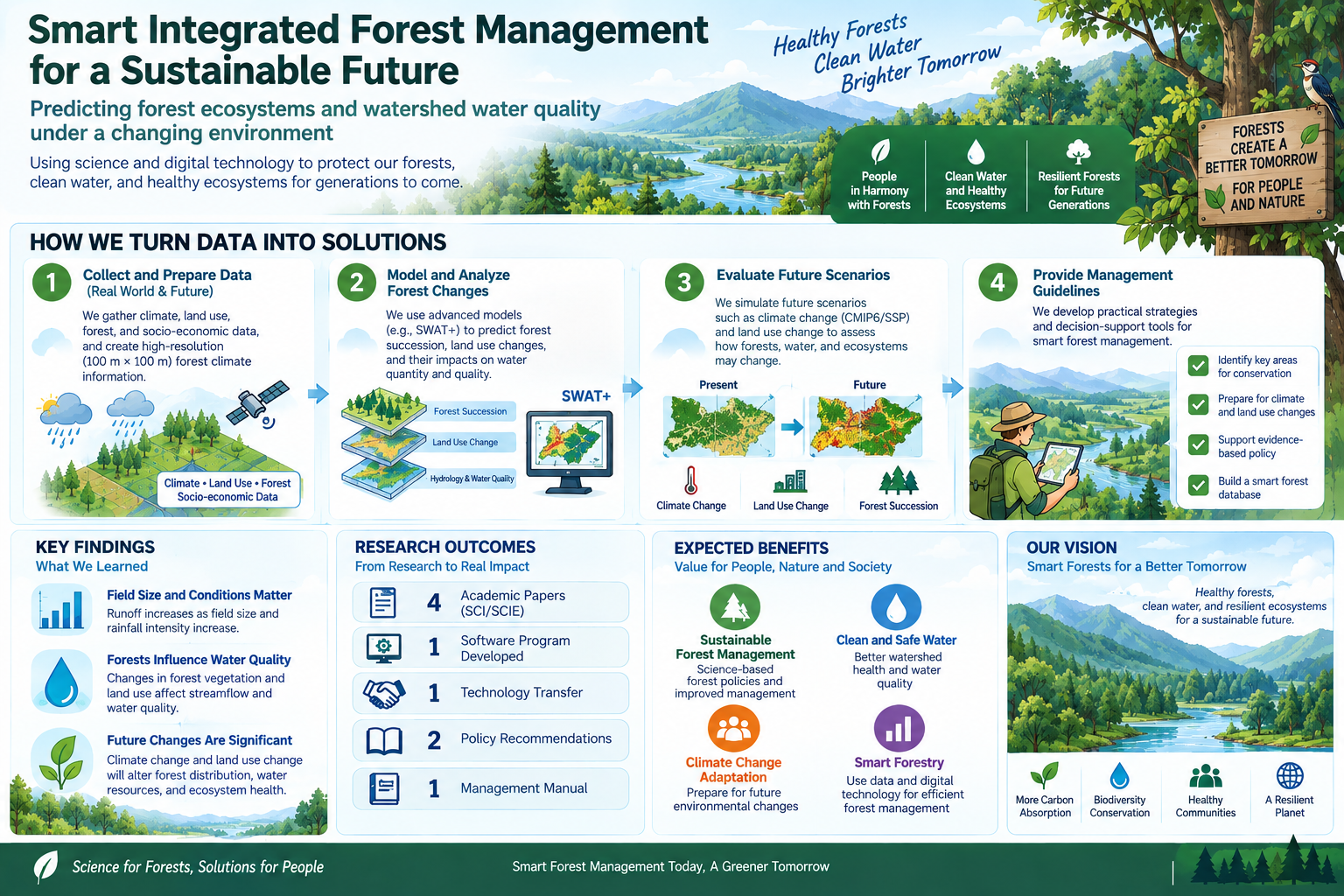
The project spatialised not only climate factors but also socio-economic development pressure as scenarios, predicting land cover and forest succession on that basis, and set out how the results should be organised into a database for integrated management. Treating forest change and water within one analytical framework supports the joint design of long-term forest management plans and basin water measures.