
Integrated Pest Management Using Seamless Climate Information, Bangladesh (CIC 405)
The Institute of Watershed Management (IWMI) and Seoul National University delivered the CIC 405 project on integrated pest management using seamless climate information. It was selected under the Climate Innovation Challenge of the Asian Disaster Preparedness Center, within the World Bank funded CARE for South Asia programme, with the Bangladesh Rice Research Institute as national partner. Work ran from January 2022 to the final report on 15 July 2022.
Pest and disease early warning rests on surveillance and prediction. Surveillance alerts farmers before heavy damage occurs; prediction anticipates when outbreaks develop, so control can be timed. Both depend on data. Pest occurrence records and matching weather observations are needed, and turning them into warnings requires understanding of pest biology, ecology and modelling. Bangladesh lacked these connections.
The project addressed this with seamless climate information: data across time scales joined into one chain, from decadal scenarios through seasonal forecasts of one to six months, sub-seasonal forecasts of 15 to 45 days, and short-range observation. IWMI developed the UniDform packages producing gridded observation, seasonal and sub-seasonal forecasts and downscaled scenarios. Seoul National University built the GMP3 package forecasting five rice diseases and insect pests. Integrated pest management decision trees covering the full range of control options completed the set, and the three were combined into the SPMP software package.
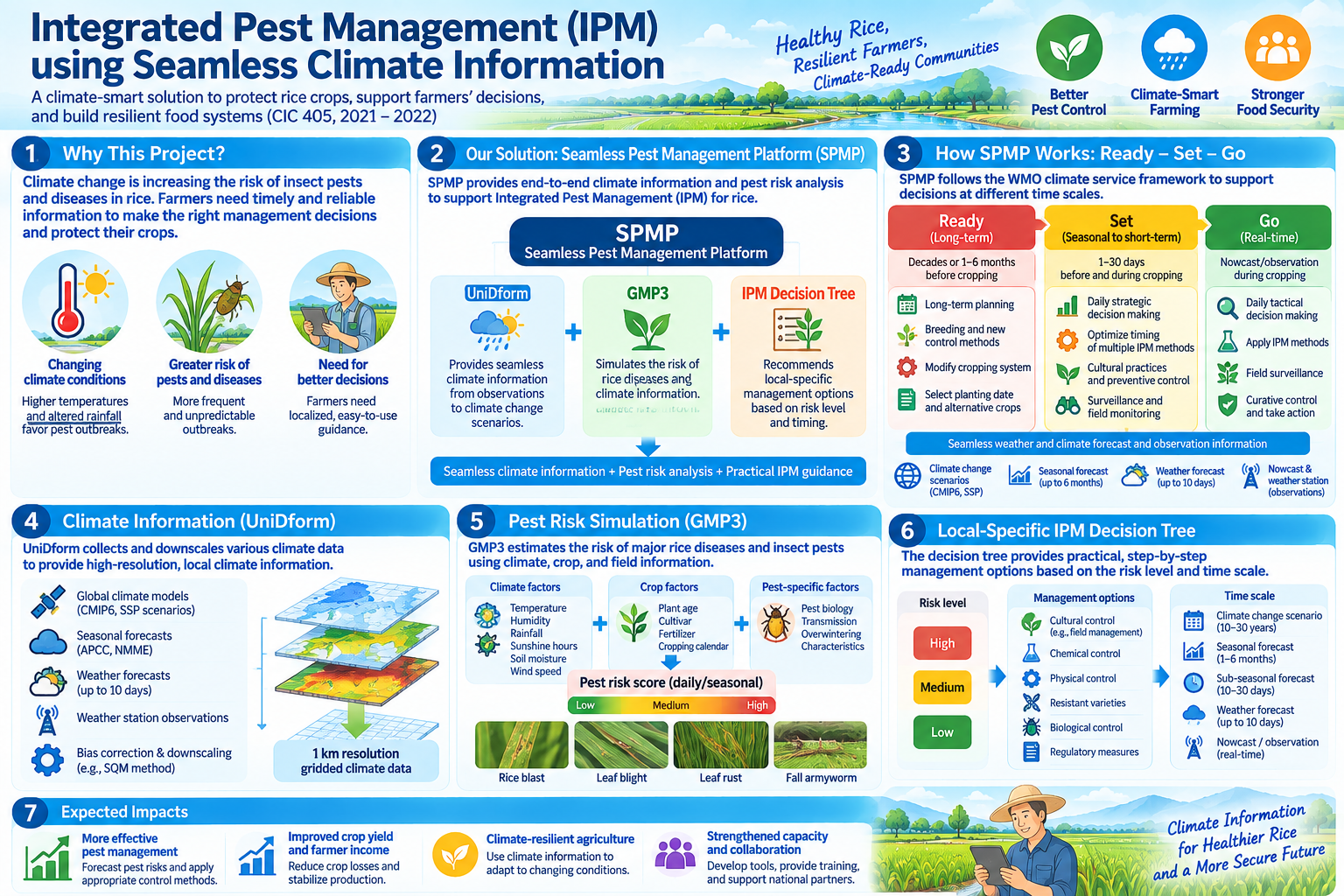
All deliverables were completed on schedule. Beyond the software, the project digitised historical pest records, assembled scattered management options systematically, and standardised the pest data collection that forecast modelling requires. Covid-19 travel restrictions were met with more frequent contact — monthly consultations, a national coordinator, a messaging group — and gaps in modelling knowledge with an introductory course and simplified calibration. Co-development giving the national partner genuine ownership was central, and the system was handed over ready for BRRI scientists to operate.