
Strategic Directions for Integrated Flood and Drought Management in the Mekong Region
In 2021 the Institute of Watershed Management (IWMI) prepared the chapter on integrated flood and drought management strategy for the Mekong region under the Knowledge Sharing Program of the Korea Development Institute, working with Professor Aksara Putthividhya of Chulalongkorn University as local expert.
Around 85 per cent of damaging natural disasters arise from meteorological events such as floods and droughts, and in the Mekong basin climate change is making both more frequent and more severe. Response in the Lower Mekong Basin has centred on flood management, with drought handled separately. The Mekong River Commission’s reorganisation of its Regional Flood Management and Mitigation Centre into a Regional Flood and Drought Management Centre expresses the principle of treating the two together. Integrated management in turn calls for a basin-centred integrated water resources management perspective.
The study began by assessing conditions in the commission and the four basin countries. Two constraints stood out: the absence of seasonal forecasts or climate outlooks for early warning, and the lack of a hydrological data sharing arrangement. The commission’s Drought Management Strategy for 2020 to 2025 sets priorities in drought indicator monitoring, forecasting and early warning, capacity building in assessment and planning, mitigation measures and information sharing. Against that framework, technology needs assessment reports from the four countries were reviewed to identify the technologies required.
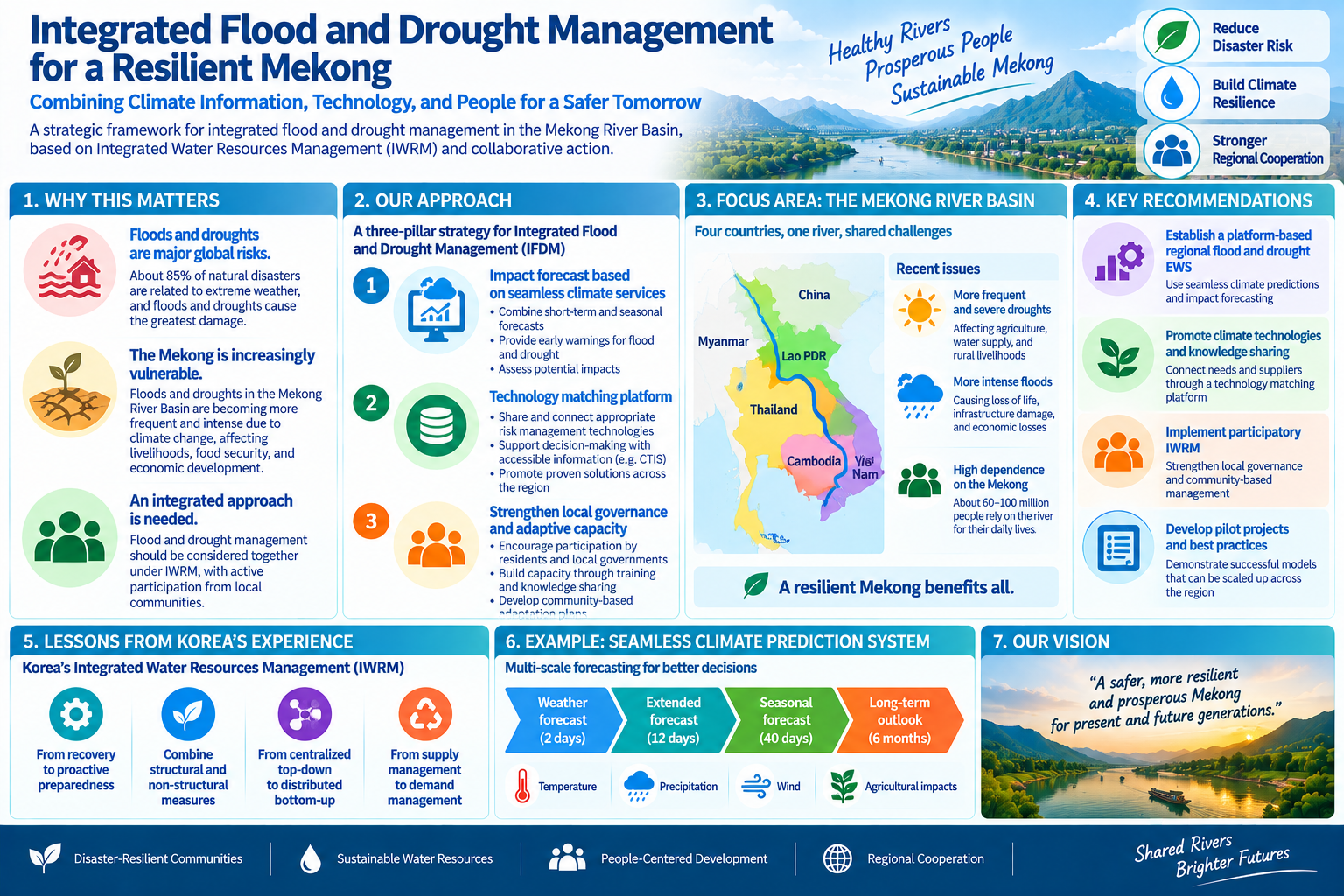
Four strategic directions were proposed: seamless climate services, a technology sharing platform, participatory demand management and capacity building. The study also states the limits of the Korean experience rather than transferring it wholesale. Korea’s own integrated water management gives insufficient weight to agricultural water, which accounted for 41 per cent of water use in 2016 and 61 per cent excluding environmental flows. The dispersed, small-scale character of agricultural water facilities applies equally in the Mekong basin.