
Climate Change Impact Assessment for the Pampanga Integrated Disaster Risk Reduction Feasibility Study, Philippines
In 2025 the Institute of Watershed Management (IWMI) prepared the climate change impact assessment chapter of the feasibility study for the second phase of the Integrated Disaster Risk Reduction and Climate Change Adaptation Project in Pampanga, the Philippines. The study was supported by Korea’s Economic Development Cooperation Fund, and the report was also prepared in English for the Philippine side.
The project area covers the Third River and Eastern Branch catchments in Pampanga province, north of Manila Bay on Luzon. The low-lying areas around Pampanga Bay suffer chronic flooding, and the project is designed as integrated disaster mitigation infrastructure to reduce flood risk and strengthen community resilience to climate change. It comprises three packages; Package 1 covers 4.15 kilometres of the lower Third River at Macabebe and Package 2 the middle reach.
The climate change impact assessment proceeded in four stages: analysis of alignment with domestic and international climate policy, analysis of climate risk in the project area, a climate risk mitigation plan, and a performance management plan. Climate response remains rhetoric in a project document unless indicators exist to confirm what was reduced and by how much.
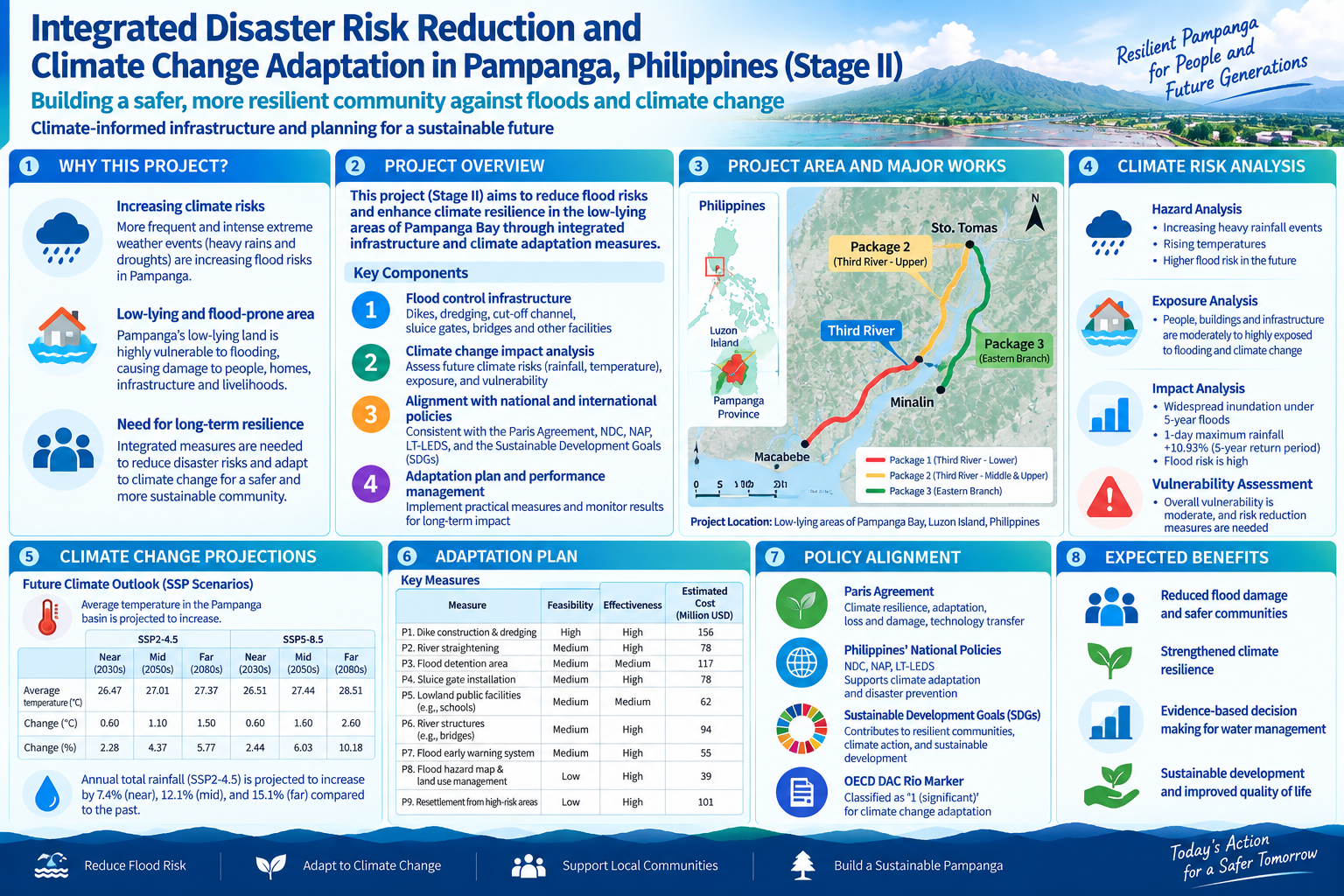
The substantive conclusion lies in the climate finance calculation. Under the fund’s guidelines, climate finance is the additional cost, that is the difference between the initial project cost without climate considerations and the total cost once climate risk mitigation measures are incorporated. IWMI analysed the detailed quantities behind the cost estimate to derive that difference and reflect it in the project budget. The work embeds climate adaptation in design and budget as a figure, and supports project approval and financing.